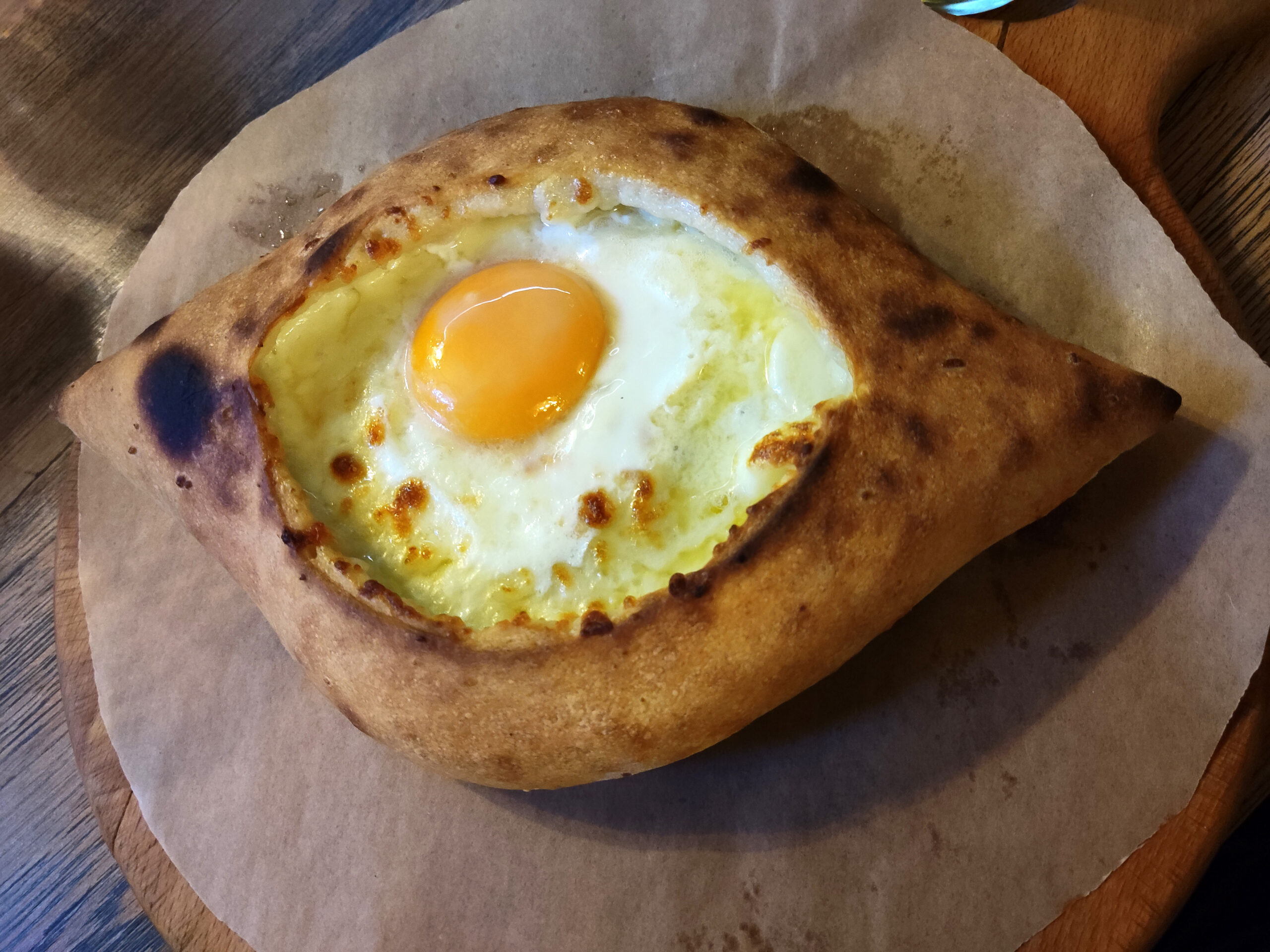
It arrives at the table still bubbling: an open oval of bread with high pinched ends, filled with molten white cheese, a knob of butter melting into it, and a raw egg yolk sitting in the middle like it was placed there as a dare. Nobody explains what to do next, and the first time, nobody gets it right.
What you do is take a fork, break the yolk, and stir it through the butter and the hot cheese until the three become one thick sauce. Then you tear off one of the pinched ends and use it to scoop. The bread is the vessel and the utensil, and by the end there is nothing left on the plate.
This is the Adjarian version, the one shaped like a boat. It is the most photographed of the Georgian cheese breads and by some distance the least understood, mostly because the cheese it depends on is difficult to buy outside the Caucasus and the substitutions people make for it are usually wrong.
- Yields: two boats, each one dinner for one hungry person or a starter for two
- Total time: about three hours, of which twenty minutes is work
- The cheese: low-moisture mozzarella and feta, roughly two to one, with a spoonful of ricotta
- Oven: as hot as it goes, 500 degrees if possible, on a preheated surface
- The egg: goes in during the last few minutes, or onto the bread out of the oven
- Yolk caution: undercooked egg is not for everyone at the table, and there is a fix below
Adjara, the boat, and the story that will not verify
Adjara is the coastal region in Georgia’s southwest corner, on the Black Sea, with Batumi as its main city. The bread carries the region’s name, and it belongs to a much larger family of Georgian cheese breads found in every province, each shaped and filled differently.
The explanation you will hear repeated is that the shape represents a boat, the egg yolk the sun setting into the sea, and the whole thing a tribute to a coastal fishing culture. It is a good story and it is told constantly by restaurants and guidebooks. What it is not is documented. No reliable source traces the shape to a deliberate maritime symbol, and it is at least as likely that the form is simply what you get when you fold the edges of a filled round upward to keep hot cheese from running off.
Where the dish is from is not in dispute, only why it looks the way it does. Georgia claims cheese bread as a national dish with no serious argument from anywhere, and the regional versions are documented well enough that the family of Georgian cheese breads can be sorted by shape with reasonable confidence.
Four other Georgian cheese breads, and how the boat differs
Knowing the siblings makes the boat easier to place. All of them use closely related dough and closely related cheese; the differences are in construction.
| Version | Shape | Cheese placement | Egg |
|---|---|---|---|
| Imeruli | Round, fully sealed | Enclosed inside | None |
| Megruli | Round, sealed | Inside and a layer on top | None |
| Adjaruli | Open oval with raised ends | Exposed, filling the well | Yolk, added at the end |
| Penovani | Square, folded corners | Enclosed, puff pastry | Wash only |
| Guruli | Folded crescent | Enclosed | Hard-boiled, chopped inside |
The boat is the only one of the five where the cheese is meant to be eaten molten and stirred rather than baked into a pocket. That single difference drives everything else: the dough has to be sturdier, the oven has to be hotter, and the cheese blend has to melt rather than merely soften. It is the same kind of structural reasoning behind the regional versions of any traditional dish, where the shape is doing a job rather than decorating one.
The dough: enriched, slack, and handled less than you expect
It is a yeasted bread dough, softened with milk or yogurt and a small amount of fat, and it should end up noticeably wetter than a standard loaf dough. Around seventy percent hydration is the right neighborhood: tacky to the hand, still holding a shape, not stiff.
For two boats: 300 grams of bread flour, 180 grams of warm milk, one large egg, 30 grams of softened butter or a tablespoon of neutral oil, 7 grams of salt, 5 grams of sugar, and 5 grams of instant yeast. Georgian recipes frequently use matsoni, a cultured yogurt, in place of some of the milk, which adds a faint tang and softens the crumb.
Mix, knead for six or seven minutes until smooth, then let it rise until roughly doubled, an hour to ninety minutes depending on the kitchen. A slow cold rise overnight in the refrigerator improves flavor considerably and costs no active time. Do not overwork it after the rise; this dough wants to stay relaxed so it can be stretched into an oval by hand without fighting back.
Sulguni, and what an American cheese counter can put in its place
Sulguni is a brined Georgian cow’s milk cheese, semi-firm, elastic, and distinctly sour, made by a pasta filata method that stretches the curd, which is why it pulls in strands when it melts. Imeruli, the other cheese usually in the filling, is fresher, milder, and saltier in a plainer way. Traditional fillings mix the two.
Neither is easy to find outside Eastern European and Caucasian grocers. The substitution has to reproduce three properties separately, because no single supermarket cheese has all of them: the stretch, the salt and sourness, and enough moisture to stay fluid rather than turning oily.
| Property of sulguni | Stand-in | Share of the blend |
|---|---|---|
| Stretch and pull | Low-moisture mozzarella, grated | About half |
| Salt and sourness | Feta, crumbled | About a quarter |
| Moisture and body | Whole-milk ricotta or farmer cheese | About a quarter |
Roughly 200 grams of blended cheese per boat. Fresh mozzarella packed in water is the wrong choice: it releases too much liquid and the filling separates into a pool. If the feta is very salty, rinse it and cut back the salt in the dough. Muenster or young havarti can replace part of the mozzarella for a softer melt.
A khachapuri recipe scaled for two boats
Have the cheese blended and the oven at full heat before shaping. Once the dough is stretched, everything moves quickly.
- Heat the oven to 500 degrees, or as high as it goes, with a baking stone or an upturned heavy sheet pan inside for at least forty-five minutes.
- Divide the risen dough in two. On a floured surface, press and stretch each piece into an oval roughly eleven inches long and seven across, leaving the center slightly thinner than the rim.
- Blend the cheeses in a bowl with a fork until evenly mixed. Reserve about a quarter of it.
- Spread the larger share of cheese down the center of each oval, leaving a border of two inches all the way around.
- Roll the long sides inward over the edge of the filling, twice, forming thick ropes. Pinch each end hard, twist, and press down so the boat has two sealed points.
- Push the reserved cheese into the well and level it. Brush the rolled rims with beaten egg or milk.
- Slide the boats onto the hot surface and bake eleven to fourteen minutes, until the rims are deeply browned and the cheese is bubbling across the whole surface.
- Pull the pan out, make a small depression in the center of the molten cheese with the back of a spoon, and drop in a yolk and a tablespoon of butter. Return to the oven for one to three minutes depending on how set you want the yolk.
Step five is the one people rush. A rim that has been rolled only once, or pinched without twisting, will unfurl in the oven and the cheese will escape.
Shaping a boat that holds instead of leaking
The rolled rim is structural. It needs to be genuinely thick, close to an inch of rolled dough, because it has to survive the cheese expanding and pushing outward as it melts. A thin decorative fold looks correct going in and flattens within four minutes.
The two ends carry the most stress. Pinch each one between thumb and forefinger, give it a quarter turn to lock the layers together, then press the point flat against the pan so it anchors. Those ends are also the first pieces torn off at the table, so they should be substantial enough to hold up to scooping.
Keep the center thin. A thick base under the cheese steams instead of baking and produces a soggy floor that tears when lifted. If the dough springs back and refuses to stay stretched, cover it and wait ten minutes; the gluten needs to relax and forcing it produces an uneven oval that bakes unevenly, which is the same principle at work in any yeasted dough that resists shaping.
Oven heat, and the eleven-minute window
This bread wants the hottest oven available and a preheated surface underneath. The goal is to set the crust and brown the rims before the cheese has time to break and release its fat, and at 400 degrees that race is lost: the cheese goes oily and the rim stays pale.
A baking stone or steel is ideal, and an upturned rimmed sheet pan preheated for forty-five minutes is a reasonable stand-in. What does not work is a cold pan going into a hot oven, because the base then bakes at the same rate as the top and never crisps.
Watch the rim rather than the clock. When the rolled edges are properly brown, not golden, the inside is done. Most home ovens land between eleven and fourteen minutes.
When the egg goes in, and how long it stays
The traditional treatment is a yolk added at the very end, barely warmed, so it stays liquid and works as a sauce ingredient rather than as a cooked egg. Some cooks add it out of the oven onto the hot cheese; others give it one to three minutes back under the heat.
Practical version, ranked by how set the yolk ends up. Straight onto the finished bread with no further baking gives a fully liquid yolk. One minute back in the oven warms it through and leaves it liquid. Three minutes gives a thickened, jammy yolk. Six minutes or more sets it firm and changes the dish, since it can no longer be stirred into a sauce.
Separate the egg cleanly. White spilling into the cheese cooks into pale streaks, so use the yolk alone, and add the butter at the same moment.
The butter, the stir, and the way it is actually eaten
The butter is not a garnish and it is not optional. A tablespoon per boat, dropped in beside the yolk, thins the melted cheese into something that can be stirred and keeps it fluid on the plate for the ten minutes it takes to eat.
At the table: break the yolk with a fork and stir it, the butter, and the cheese together until the mixture is uniform and glossy. Do this immediately, while everything is still very hot, because a cooled filling will not emulsify and stays a solid mass.
Then tear off one of the pinched ends and drag it through. Work inward from the ends, tearing pieces of the rim and dipping, until only the base is left. Georgians drink it with something sharp and cold. A dry white or a plain sparkling water does more for it than anything sweet.
Leaks, sags, and a puddle of oil: three causes
Cheese escaping over the rim is a shaping failure, not an oven failure. Either the border was too narrow, the roll was single rather than double, or the ends were pinched without twisting. Rebuild the rim thicker on the next one and it stops.
A greasy pool sitting on top of the filling means the cheese broke, which happens when a high-fat, low-moisture cheese is held too long at moderate heat. Raise the oven temperature, cut the bake shorter, and add more of the fresh cheese component to the blend. Aged cheddar and other hard cheeses break especially easily and belong out of the mix.
A soggy base is nearly always a cold pan or a center rolled too thick. Preheat the surface properly and roll the middle of the oval thinner than the edges. If the base has already gone soft, a few minutes directly on the oven rack will recover some of it.
The soft yolk question, and who should skip it
A yolk warmed for a minute is not cooked, and undercooked eggs can carry salmonella. That risk is not evenly distributed. Pregnant women, young children, adults over sixty-five, and anyone with a compromised immune system are advised against runny eggs, and this dish puts one in the center of the plate by design.
Two workable answers. Pasteurized shell eggs are sold in most large supermarkets, behave identically, and remove the concern entirely. Or leave the boat in for five or six extra minutes so the yolk sets firm, which changes the texture of the dish but keeps everything else intact. General handling and cooking guidance for eggs is published by public food safety authorities and is worth following for any dish built around a soft yolk.
The rest of it is straightforward. Cheese-filled bread should not sit at room temperature for more than a couple of hours, and leftovers go into the refrigerator and get reheated in a hot oven rather than a microwave. In practice there are rarely leftovers.
Frequently Asked Questions
Can I make the dough the day before?
Yes, and it is the better method. Mix the dough, give it thirty minutes at room temperature, then refrigerate it overnight. The slow cold fermentation develops flavor the fast rise cannot, and the chilled dough is easier to stretch. Let it sit out for forty minutes before shaping.
What if I cannot find feta?
Any firm, salty, brined white cheese does the same job. Bulgarian or Greek sheep’s milk cheese, Turkish beyaz peynir, or a well-drained queso fresco with extra salt all work. What you need from that quarter of the blend is salt and acidity, not a specific origin.
Is it supposed to be eaten as a whole meal?
One boat is a substantial meal for one person, and it is often eaten that way. Split between two as a starter it works better alongside something sharp: a tomato and cucumber salad, or pickled vegetables, both of which cut through the fat and salt.
Can I freeze them?
Freeze the shaped, filled boats before baking, without the egg, on a tray until solid, then wrap. Bake from frozen at the same temperature, adding about five minutes. Baked and frozen ones lose the texture of the filling entirely and are not worth the freezer space.
Why is my cheese filling stringy rather than creamy?
Too much mozzarella and not enough of the moist component. Mozzarella supplies the pull, but on its own it sets into ropes as it cools. Increasing the ricotta or farmer cheese to a third of the blend gives a filling that stays spoonable, and the butter stirred in at the end does the rest.
Make the dough on a Saturday morning, shape it in the evening, and give everyone a fork and no instructions. Watching a table work out on its own that the bread is the spoon is most of the pleasure of serving it.