The first pot I made tasted like sauerkraut with meat in it. Sour, one-dimensional, and faintly disappointing after four hours of work. The same pot on Wednesday tasted like something else entirely: darker, rounder, with the sourness folded into the meat instead of sitting on top of it. I had done nothing to it except let it get cold twice.
That is the whole argument of the dish. Bigos is not a stew that keeps well as a bonus. It is a stew that is deliberately made days before it is served, cooled all the way down, reheated, cooled again, and finally eaten when the cabbage has stopped being cabbage and the fat has redistributed through everything.
What follows is what goes in the pot, why the reheating changes it, how the cooling is done without turning a good dish into a food safety problem, and how much of the tradition survives a modern kitchen with a refrigerator in it.
- Cabbage: roughly half sauerkraut, half fresh white cabbage, adjusted to taste
- Meat: at least three kinds, one smoked, one fatty, one that shreds
- Mushrooms: dried wild ones, plus their soaking liquid
- Time: about three hours the first day, one hour on each later day
- Best on: day three, by nearly every account including mine
- The rule that matters: cool it fast in shallow containers and reheat it to a hard boil, not on the back of the stove overnight
What goes in the pot, and what varies house to house
Every version has cabbage in two forms and more than one kind of meat. Past that, the variations are real and old. Some households use only sauerkraut. Some add tomato paste and some consider that a modern intrusion. Prunes appear in a great many recipes and are absent from a great many others.
The constants worth treating as constants: sauerkraut, some fresh cabbage, smoked sausage, a fatty cut of pork, dried mushrooms, bay leaf, allspice berries, juniper, and marjoram. The variables: prunes, tomato, red wine, beer, honey, caraway, and whatever roast meat was left over from the weekend.
The leftover element is not a decorative detail. Bigos historically absorbed whatever was around, which is why so many family recipes include a line about adding cold roast or the end of a ham. A pot built entirely from ingredients bought for it tastes slightly too tidy, and that is a real difference you can taste against a pot that had three odds and ends thrown in.
Mickiewicz, hunting parties, and what can be documented
The name of the dish, bigos, is usually translated as hunter’s stew, and the association with hunting is genuinely old. The most quoted source is literary rather than culinary: Adam Mickiewicz devoted a passage of his 1834 epic Pan Tadeusz to bigos being cooked in the forest, and that passage is why every Polish schoolchild knows the word.
What is not documented is a clean origin story. Claims about a specific century, a specific court, or a specific ruler introducing it circulate widely and none of them rest on a source anyone can point to. The honest position is that a stew of preserved cabbage and preserved meat is what a cold country with a long winter produces, and that it was recorded once it was already ordinary.
The hunting connection makes practical sense regardless of the origin. A dish that improves over days, travels in a pot, and reheats over an open fire is what a party away from a kitchen wants, and it is the same logic that shaped most food that outlived the households that invented it.
Sauerkraut and fresh cabbage, and the ratio nobody agrees on
Fresh cabbage brings sweetness and body. Sauerkraut brings acid and the fermented note that makes the dish what it is. All sauerkraut gives a sharp, aggressive pot that some regions prefer and most people outside them find punishing. All fresh cabbage is not bigos at all.
Half and half by weight is the starting point, and adjusting from there is a matter of the kraut rather than the recipe. Sauerkraut varies enormously in sourness depending on how long it fermented and what was done to it afterwards.
Taste the kraut before it goes in. If it makes you wince, rinse it briefly in cold water and squeeze it out, which removes a surprising amount of sharpness without touching the flavour underneath. If it tastes mild and slightly sweet, use it straight from the bag with its liquid. Refrigerated kraut in a bag or jar, the kind still alive rather than pasteurised in a can, is worth seeking out for the same reasons that apply across anything that gets its flavour from live fermentation.
Three meats, and the job each one is doing
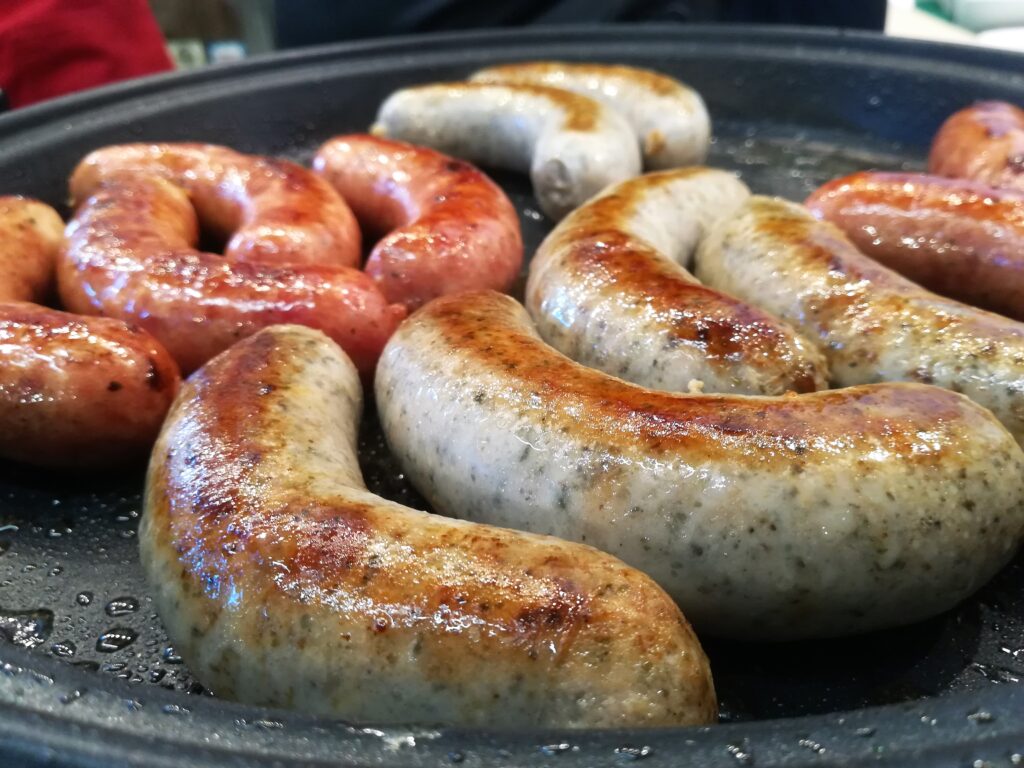
The mixture is the point. One meat gives a stew with a single note, and no amount of seasoning fixes that. Three gives layers that separate over the days of reheating.
| Meat | What it contributes | Amount for a large pot | Goes in |
|---|---|---|---|
| Pork shoulder | Body and shreds, absorbs the sourness | About 2 pounds, cubed | Browned first, in at the start |
| Smoked bacon or slab | Fat and smoke through the whole pot | Half a pound, diced | Rendered first, before anything else |
| Kielbasa | Spice, garlic, and pieces you can identify | A pound, thick coins | Halfway through, or it disintegrates |
| Beef chuck or game | Depth, a darker background | Half a pound, optional | With the pork |
| Leftover roast | Whatever it was, plus its fat | Whatever there is | Last hour of the first day |
Brown the fresh meat properly and in batches, which is twenty minutes of work that most of the flavour depends on. The smoked meat does not need browning; it needs rendering, gently, so the fat comes out and the rest of the vegetables cook in it.
Dried mushrooms, and the soaking water that is stock
Dried wild mushrooms, usually boletes of some kind, do more here than their volume suggests. An ounce of them, soaked in hot water for half an hour, contributes a meaty background that fresh mushrooms cannot approach because drying concentrates exactly the compounds that read as savoury.
The soaking liquid is the more valuable half. Pour it into the pot, leaving the last tablespoon behind because grit settles there, and you have added a dark, concentrated stock that costs nothing. People throw it away constantly.
Chop the rehydrated mushrooms rather than adding them whole, since whole caps stay chewy through a long cook and read as an odd texture in a dish where everything else has gone soft. If dried wild mushrooms are hard to find, dried porcini from an Italian shelf are the same category of ingredient and behave identically.
A bigos recipe for a large Dutch oven
- Soak an ounce of dried mushrooms in two cups of hot water. Leave them thirty minutes.
- Render half a pound of diced smoked bacon in a large heavy pot over medium heat until the fat runs and the pieces colour. Lift them out.
- Brown two pounds of cubed pork shoulder in that fat, in three batches, with salt and pepper. Do not crowd the pot. Set the meat aside.
- Cook two large sliced onions in the same pot until soft and golden, about twelve minutes, scraping up everything stuck to the bottom.
- Add a shredded small head of white cabbage and cook it down for ten minutes until it collapses and starts to catch colour.
- Add two pounds of sauerkraut, drained and chopped, with the mushrooms and their strained soaking liquid.
- Return the pork and bacon. Add two bay leaves, six allspice berries, eight juniper berries, a tablespoon of dried marjoram and a teaspoon of caraway. Pour in a cup of dry red wine and enough water to come halfway up.
- Bring it to a simmer, cover, and cook at the barest bubble for two hours, stirring every half hour and scraping the bottom.
- Add a pound of kielbasa in thick coins, ten pitted prunes chopped, and two tablespoons of tomato paste. Cook uncovered for another forty-five minutes until the liquid is thick rather than soupy.
- Taste for salt, sourness and sweetness. Adjust with a little kraut brine, a spoonful of honey, or nothing at all.
- Cool it down properly, refrigerate, and reheat it the next day and the day after. Serve on the third day with rye bread and boiled potatoes.
Prunes, wine, and the sweetness question
The prunes are there to answer the kraut. Ten chopped pitted prunes in a large pot do not make it a sweet dish; they take the sharpest edge off the acid and add a dark fruit note that reads as depth rather than as fruit. Smoked prunes, where they are available, are better still.
Wine is optional and useful. A cup of dry red adds tannin and colour and helps the long cook. Dark beer does a related job with more malt and less structure. Neither is traditional in every household and a pot made with water is not a lesser pot, only a plainer one.
Honey is the correction of last resort. If a finished pot tastes shrill after all the cooking, a teaspoon of honey stirred in at the end rounds it without making it sweet. Add it in small amounts and taste between them, because it cannot be taken back out.
Cooling it down is the technique, not the storage
Something specific happens when a pot of this goes cold. Fat that was floating solidifies and redistributes through the cabbage rather than sitting on top. Starch and pectin from the cabbage and onions set and then loosen again on reheating, which thickens the liquid. And the sourness, which is volatile in a hot pot, settles into the meat.
The second cook does more of the same. By the third heating the individual ingredients have stopped being identifiable: the cabbage is not sour, the pork is not pork-flavoured, and the whole pot tastes of one thing. That is the state people mean when they say bigos is better on the third day, and it is not nostalgia. Cook the same batch and taste it on each day if you want the point proven.
Three cycles is where the improvement flattens. A pot reheated for a week gets darker and softer without getting better, and the kielbasa eventually turns to mush. Three days is the target, four is fine, seven is a different and worse dish.
Doing the cooling safely, which the old method did not
The traditional version of this involves leaving the covered pot on a cold porch or an unheated pantry between servings. That worked in a Polish winter with a stone larder and it does not translate to a warm kitchen, and it is the one part of the tradition worth replacing outright.
A deep pot of stew cools very slowly. The middle of a full Dutch oven can sit for hours in the temperature range where bacteria multiply fastest, which is exactly the risk that public food safety guidance addresses with the two-hour rule. Divide the pot between two or three shallow containers, leave them uncovered until the steam stops, and get them into the refrigerator well inside two hours. Shallow and uncovered is the whole method; a lid on a hot container traps the heat you are trying to lose.
Reheat the same way every time: bring it to a full, visible boil and hold it there for a couple of minutes, stirring, rather than warming it through. Do not leave the pot out on the counter to cool overnight between reheatings, and do not reheat only the portion on top of a cold pot. If it has been forgotten on the stove for hours, throw it out. Cabbage and pork do not signal spoilage clearly, and the dish smells strong even when it is perfect, so smell is not a reliable test here.
Where it goes wrong, and five causes
Scorching is the most common failure and it comes from a pot that is too thin or a flame that is too high. Cabbage sticks and burns quietly, and once a burnt note is in the pot nothing removes it. Use the heaviest pot in the kitchen, keep the simmer barely moving, and scrape the bottom every half hour.
Watery bigos comes from adding liquid at the start as though it were a soup. The cabbage releases a great deal of water and the pot should start nearly dry. If it ends up thin, take the lid off for the last hour.
The other three: too sour, from unrinsed aggressive kraut and no prunes; too flat, from one meat and no smoke; and mushy sausage, from putting the kielbasa in at the beginning instead of halfway through. None of them can be corrected after the fact, which is why a large batch is worth tasting and adjusting before it goes into the refrigerator, the same discipline that makes any pot cooked for a crowd work.
Serving it, freezing it, and how long a pot lasts
It goes with rye bread and not much else. Boiled potatoes are common, a plain one at that, and mashed potato works if the pot is on the thin side. Anything with its own strong flavour competes and loses.
Refrigerated and reheated properly, a pot is good for about four days from the day it was made. Freezing works well and it is the traditional endpoint for a large batch: portion it flat in bags, freeze, and thaw in the refrigerator rather than on the counter. Frozen bigos comes back noticeably closer to its original state than most stews do, because the cabbage has already broken down as far as it is going to.
Scale up rather than down. This is a dish whose whole logic depends on being made in a quantity too large to finish, and a small pot deprives it of the days it needs to become itself. Cook a pot for eight, eat it four times, and freeze the rest, which is roughly what every household that makes it regularly does with stews built to last a week.
Frequently Asked Questions
Can I make bigos in a slow cooker?
Partly. Brown the meats and cook down the fresh cabbage in a pan first, since a slow cooker will not do either, then transfer everything and cook on low for six hours. The reheating cycles still have to happen in a pot on the stove, because a slow cooker heats too gently to bring the batch to a proper boil.
Is it always made with pork?
Overwhelmingly, but not exclusively. Game versions with venison, boar or hare are old and are what the hunting association refers to. Beef appears in plenty of household recipes. A version without any meat exists, built on mushrooms and smoked plums, and it is a decent dish that no one would mistake for the original.
Do I have to use dried mushrooms?
They are the ingredient I would fight hardest to keep. Fresh mushrooms contribute a fraction of the same flavour and none of the stock. If they are genuinely unavailable, a spoonful of tomato paste and a longer browning of the onions closes some of the gap.
How sour should the finished pot be?
Noticeably sour but not sharp. It should read the way a good sourdough reads, as a background that shapes everything else rather than as the first thing you taste. If the sourness arrives before the meat does, the kraut needed rinsing.
Can I skip the multi-day process and just eat it?
You can, and it will be a decent cabbage and pork stew. What you will not have is the thing people are describing when they talk about this dish, which only appears after the second cooling. If time is short, make it two days ahead rather than three, but making it the same afternoon misses the point.
Start it on a Saturday morning, taste a bowl that evening so you know what the baseline was, and leave the rest alone until Monday. The difference between those two bowls is the entire reason the dish is cooked this way.