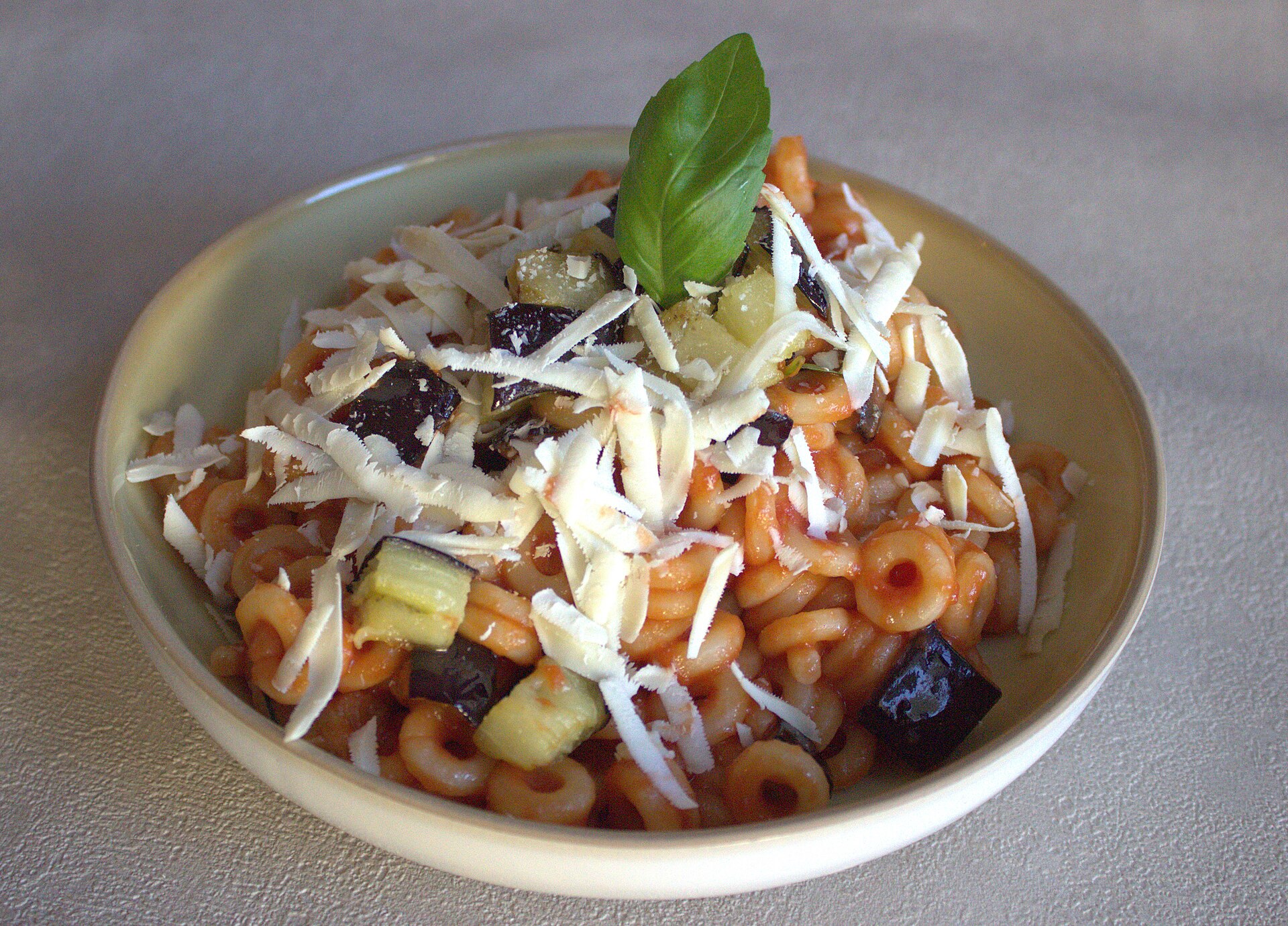
Order this in Catania and four things arrive on the plate: short pasta, a plain tomato sauce, fried eggplant, and a drift of hard white cheese grated over the top. Nothing is hidden and nothing is complicated. The dish is on the menu of nearly every trattoria on the eastern side of Sicily, under Etna, and it has been for a very long time.
Arguments about it never concern the tomato. They concern two decisions. The first is what to do with the eggplant, which is where salting and frying come in. The second is the cheese, and on that one the room is less divided than it looks, because the cheese is not a garnish here. It is a structural ingredient, and the wrong one produces a perfectly nice plate of something else.
Below is the version cooked in Catania, the honest weeknight variation, and the specific reasons each decision goes the way it does.
- Serves: four, generously
- Time: 45 minutes fried, 55 roasted, plus 45 minutes of salting
- Difficulty: low, with one step that needs attention (the frying)
- The five ingredients that matter: eggplant, tomato, basil, ricotta salata, olive oil
- What to leave out: onion, sugar, oregano, cream, and every other cheese
- Make ahead: sauce and eggplant separately, up to two days; never assembled
Catania, an opera, and a name nobody can document
Vincenzo Bellini was born in Catania in 1801 and wrote Norma, which had its first performance at La Scala in Milan at the end of 1831. He died four years later, at thirty-three, and the city has claimed him ever since. The dish carries the name of that opera.
The rest of the story is repeated everywhere and documented nowhere. In the usual telling, the Catanese writer Nino Martoglio was served a plate of it and declared it a real Norma, meaning a masterpiece, and the name stuck. No contemporary source records the moment, the anecdote appears in print long after both men were dead, and it should be read as a local tradition rather than a fact. That is not a reason to stop telling it. It is a reason not to present it as history.
What is solid is the geography. Every component grows within reach of the city: eggplant and tomato from the plain, basil from a pot on a balcony, sheep’s milk cheese from the interior, durum wheat from central Sicily. The dish is what the eastern Sicilian countryside puts on a table in late summer, which is also the season it tastes best. For the broader picture of how a region’s pantry writes its own menu, our survey of how regional traditions shape a plate makes the same point across several countries. You can read more about the dish’s documented and disputed origins if you want the sources laid out.
What goes in a pasta alla norma recipe, and what does not
For four people: a pound of short dried pasta, two medium eggplants at about a pound and a half together, a 28-ounce can of whole peeled tomatoes or two pounds of ripe fresh ones, two garlic cloves, a generous bunch of basil, three and a half ounces of ricotta salata, olive oil, and salt.
That is the entire list. No onion, because the eggplant already carries the sweetness the sauce needs. No sugar, no oregano, no cream, no anchovy, no chile. Every one of those additions makes a decent dish and none of them makes this one. The discipline is the point: four flavors, each of them clearly audible.
On the eggplant, Sicilian cooks use the round to oval purple varieties sold in the markets there, and in an American store the globe eggplant is the direct equivalent. Long, slender Japanese or Chinese eggplants have thinner skin and fewer seeds and fry beautifully, but they collapse into softness rather than holding as chunks, so the finished plate reads smoother and less meaty. Either works. They are not the same result.
The salting question, settled
The traditional reason for salting eggplant was bitterness, and that reason has largely expired. Commercial varieties have been bred for decades toward milder flesh, and a fresh globe eggplant bought in season is rarely bitter enough to notice.
Salt still earns its forty-five minutes, for a different reason. Eggplant flesh is mostly air held in a spongy structure, and that structure is what drinks oil. Salt pulls water out through osmosis and collapses the sponge, so the cut surfaces brown instead of steaming and the pieces take up markedly less oil in the pan. Cut the eggplant into three-quarter-inch cubes, toss with about a teaspoon of kosher salt per pound, and leave it in a colander for forty-five minutes. Beads of brown liquid will sit on the surface.
Then press it dry, hard, between two clean towels. This is also a safety step and not a fussy one: wet eggplant dropped into hot oil spatters violently. If you have decided to roast rather than fry, salting matters much less and you can skip it, because a dry oven does the water removal on its own.
Fried or roasted, and what each one costs you
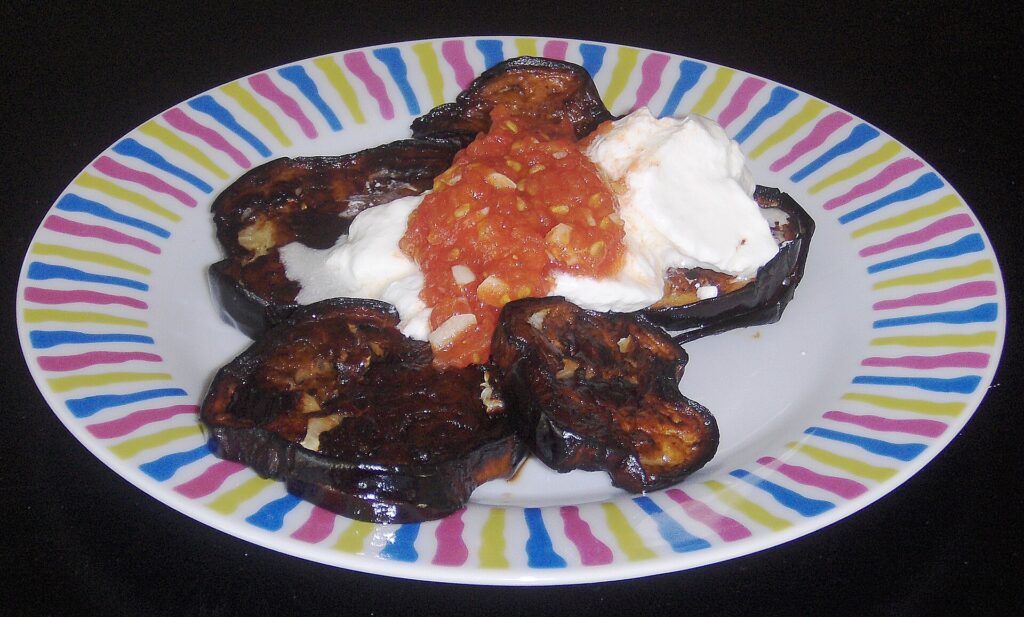
Frying is the Catania method and it produces the dish people remember: a browned exterior, a creamy interior, and eggplant that carries seasoned oil into every forkful. Roasting produces something drier, more concentrated, and chewier at the edges, using roughly a quarter of the oil and almost none of the attention.
| Fried | Roasted | |
|---|---|---|
| Oil | About 1 cup in the pan, some absorbed | 3 tablespoons, all absorbed |
| Time | 15 minutes in batches | 25 to 30 minutes, unattended |
| Texture | Crisp edge, custardy center | Dense, chewy, concentrated |
| Attention | Constant | One flip |
| Cleanup | A pan of used oil | One sheet pan |
| Best for | The dish as it is cooked in Sicily | A Wednesday |
The honest position is that these are two dishes with one name. The roasted one is genuinely good and I cook it more often than the fried one. It is simply not what arrives at a table in Catania, and calling it the same thing does neither version any favors.
The tomato stays plain
Two garlic cloves, smashed but whole, in a quarter cup of olive oil over medium-low heat until they perfume the oil and turn pale gold, about three minutes. Pull them out or leave them in. Add a 28-ounce can of whole peeled tomatoes crushed by hand, a good pinch of salt, and let it go at a lazy simmer for twenty to twenty-five minutes, until it coats a spoon and the oil starts to show at the edges.
Basil goes in at the end, off the heat, torn rather than cut. That is the whole sauce. Building a sofrito of onion and carrot underneath it produces a heavier, sweeter, more northern sauce that swallows the eggplant, which is exactly what this dish is trying to avoid.
Canned or fresh is a seasonal question, not a purity question. In late summer, ripe fresh tomatoes peeled and chopped are better than anything in a tin. In February, good canned whole peeled tomatoes beat pale imported fresh ones by a wide margin, and pretending otherwise is how people end up with a watery pink sauce.
Why the cheese has to be ricotta salata
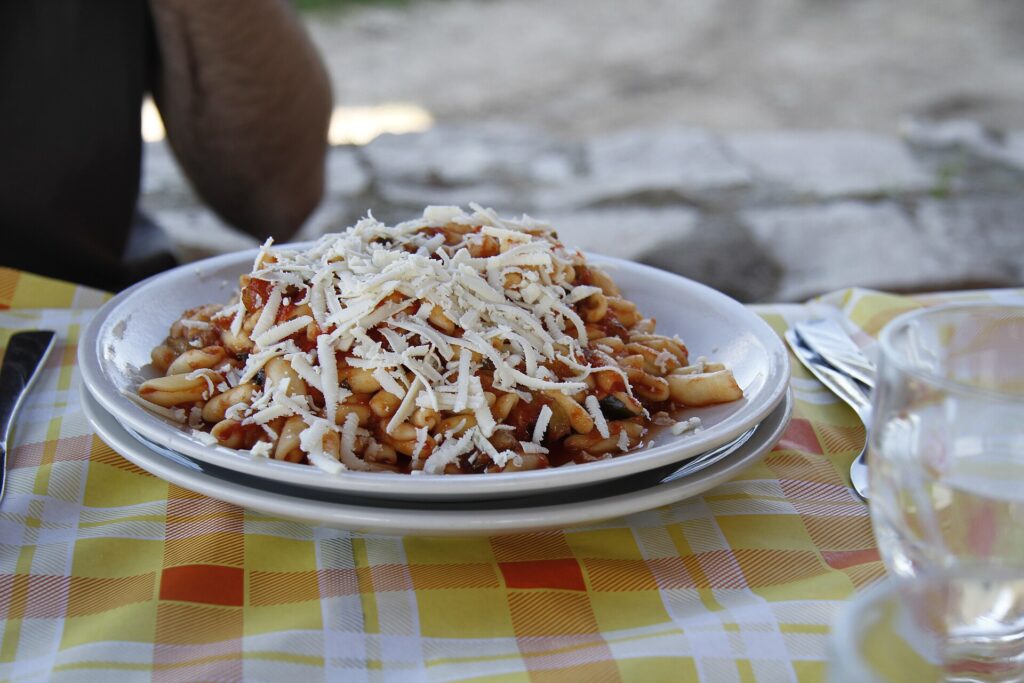
Ricotta salata is sheep’s milk ricotta that has been drained, pressed, salted, and aged for a few months. It comes out firm, chalk white, and dry enough to grate on a box grater, salty with a faint milky tang behind it. Critically, it does not melt.
It does three jobs here at once. It delivers salt in discrete grains that dissolve on the tongue rather than disappearing into the sauce, so each bite gets a small spike. It provides a dry, crumbly texture against soft eggplant and wet tomato, which is the only textural contrast on the plate. And it supplies a mild lactic background that stays behind the eggplant instead of climbing over it.
Every common substitute breaks one of those jobs. Pecorino romano is sharper, saltier, and much fattier, and it melts into the sauce and takes it over. Parmigiano brings nutty umami that pulls the whole plate northward. Feta is brined and wet, so it adds moisture the dish does not want along with a tang that fights the tomato. If ricotta salata is genuinely unavailable, the nearest approach is a firm block of feta rinsed and left uncovered in the refrigerator overnight to dry out, which gets you the crumble and the salt without the milky quiet. Grate it on the large holes or shave it in flakes, and add it at the plate.
The pasta shape, and the water
Catania uses short tubes, usually rigatoni, sedani, or the local maccheroni, and a long version with spaghetti is common enough that nobody will object. Ridges matter more than shape, because this sauce is loose and needs something to catch on.
Salt the water at roughly a tablespoon of kosher salt per four quarts. The instruction to make it taste like the sea overshoots, and oversalted water plus a salty cheese lands the finished plate somewhere unpleasant. Reserve a full cup of the starchy cooking water before draining, every time.
Drain a minute short of the time on the box. The pasta finishes in the pan with the sauce and a ladle of that water, tossed hard for sixty to ninety seconds, which is what turns sauce and pasta into one thing rather than two. This is the same emulsion that carries any good dressed pasta, whether the noodles came from a box or from the sheet you rolled out yourself.
The method, start to finish
- Cut the eggplant into three-quarter-inch cubes, salt, and drain in a colander for 45 minutes. Press dry between towels.
- Warm the garlic in olive oil until it perfumes. Add the hand-crushed tomatoes and a pinch of salt.
- Simmer the sauce 20 to 25 minutes, uncovered, until it coats a spoon. Keep it at a lazy bubble.
- Heat half an inch of olive oil in a wide pan to 340 degrees. Fry the eggplant in batches, without crowding, 4 to 5 minutes per batch, until deep gold on all sides.
- Drain the fried cubes on a wire rack, not on paper, and salt them lightly while hot.
- Boil the pasta in well salted water. Reserve a cup of the water and drain one minute early.
- Fold three-quarters of the eggplant into the sauce off the heat. Hold the rest back for the top.
- Tip the pasta into the wide pan with the sauce, add a splash of the pasta water, and toss over medium heat for 60 to 90 seconds.
- Tear in the basil and check the salt. Remember the cheese is still coming.
- Plate, scatter the reserved eggplant on top, and grate the ricotta salata over each bowl at the table.
Frying safely, and how much oil the eggplant really takes
Half an inch of oil in a wide, heavy pan, held between 340 and 350 degrees. A cube of eggplant should sizzle immediately and steadily; if it sits quietly, the oil is too cool and the piece is absorbing rather than frying, which is the entire reason people believe fried eggplant is greasy.
Do not fill the pan more than a third of the way. Keep a lid within arm’s reach, dry the eggplant properly, and do not move a pan of hot oil until it has cooled. Add pieces with a spider or tongs rather than tipping them in from a bowl. None of this is exotic, and all of it is the difference between an ordinary evening and a burn.
On the nutrition question, treat any number you see as an estimate, because the variable that dominates is how much oil the eggplant took up and that changes with temperature, cut size, and how well it was dried. A generous fried portion of this plate sits in the same range as most rich pasta dishes; the roasted version comes in appreciably lower on fat for the same weight of food. Salted, dried, and fried hot, eggplant absorbs a fraction of what it takes on at low temperature.
Where it goes wrong
Oil below temperature. The most common fault by a wide margin, and the one that gives the dish its bad reputation. Use a thermometer once and you will recognize the sound afterward.
Eggplant cut too small. Half-inch dice disappears into the sauce and the plate loses its whole point. Three-quarters of an inch survives frying and stays identifiable on the fork.
Sauce cooked too far. Past thirty minutes the tomato turns into jam, and the sweetness collides with the eggplant. It should still be loose enough to move in the pan.
Cheese added in the pan. Ricotta salata is dry and salty and heat makes it clump and squeak. It goes on at the plate, over the top, and never gets stirred in.
Pasta cooked to the box. The full time plus 90 seconds in the pan is 90 seconds too long. Pull it early, always.
Frequently Asked Questions
Can I make it ahead?
The sauce and the fried eggplant both keep two days in the refrigerator, stored separately. Assembled, it does not hold at all: the eggplant goes soft and the pasta keeps drinking sauce until the whole bowl is dry. Reheat the sauce, warm the eggplant in a hot dry pan for a minute, and boil fresh pasta.
Do I need to peel the eggplant?
No, and Sicilian cooks generally do not. If the skin on a large late-season eggplant looks thick and leathery, peel it in stripes with a vegetable peeler, leaving alternating bands. That keeps enough skin to hold the cubes together in the pan.
What if I cannot find ricotta salata?
Look in an Italian grocery before you give up, since it is widely imported and keeps for weeks wrapped in the refrigerator. Failing that, dry out a block of firm feta uncovered overnight and grate it, and accept that the result is brighter and tangier than it should be. Pecorino and parmigiano both make good plates of something else.
Is there a version without cheese?
Yes, and it is Sicilian rather than a modern compromise. Toasted breadcrumbs fried in olive oil with a little garlic, scattered over the top, are the traditional stand-in across the island, and they supply the same crunch and salt. The dish is vegetarian as written and becomes vegan with that swap.
Fresh tomatoes or canned?
Fresh when they are in season and heavy for their size, canned the rest of the year. If you use fresh, peel them, since the skins curl into unpleasant strips in a long simmer, and expect to cook the sauce five to ten minutes longer to drive off the extra water.
Cook it once with fried eggplant on a Sunday and once with roasted eggplant on a weeknight, and you will know which decision you actually care about. The cheese, though, is not a decision. It is the reason the plate tastes the way it is supposed to.