Cut into it the hour it is assembled and you get six dry gingerbread rounds with apple butter smeared between them. Cut into it the next afternoon and you get one dense, moist, spiced slab that holds a clean edge on a plate. Nothing was done in between. The cake sat on a counter under a plate and finished itself.
That waiting is the technique. Every other decision in this cake, and there are several worth getting right, exists to make the overnight rest work: layers thin enough to absorb, a filling wet enough to give something up, and a dough stiff enough that it does not turn to mush when it does.
It is a mountain cake, built when sugar was expensive, ovens were small, and the fruit in the house in January had been dried on a screen the previous September. Here is how it goes together and what the night in the pantry is actually doing.
- Makes: one cake of six layers, twelve to sixteen servings
- Active time: about 90 minutes, plus 12 to 24 hours of resting
- Layers: rolled a quarter inch thick, baked 8 to 10 minutes, and they will look wrong coming out
- Filling: dried apples, cooked down. Fresh apples do not work and the reason is water
- Sweetener: sorghum syrup, or molasses at a cost
- Best eaten: day two. Day three is better still
A cake that is not finished when it leaves the oven
Most cakes are at their peak within a few hours of baking and decline from there. This one runs the opposite way, and the reason is that it is assembled deliberately out of balance: the layers come out of the oven dry and firm, and the filling goes on wetter than any filling should be.
Water moves from the wet side to the dry side. Over twelve to twenty-four hours the filling gives up moisture into the surrounding cake, the layers soften and swell slightly, and the boundary between cake and apple stops being a boundary. A cake that was six things becomes one thing.
That is why the recipe cannot be shortened and why every instruction below points at it. A layer baked soft has nothing to absorb with. A filling cooked down too far has nothing to give. Both mistakes produce something edible on the day and disappointing on the second, which is the day that matters.
The wedding story, and what can be documented
The story goes that a bride’s family could not afford a proper wedding cake, so guests each brought a layer, and the layers were stacked with apple filling as they arrived. The number of layers indicated how well liked the couple was. Versions of this are told across eastern Kentucky, east Tennessee, western North Carolina and southwest Virginia.
It is a good story and it is not a documented one. No contemporary account records the practice, the earliest printed recipes are much later than the tradition they describe, and the tale appears in the form that oral history usually takes, which is with confident detail and no source. Treat it as folklore that reflects something true about the setting rather than as an event that happened.
What the cake does document is economics. A household in the southern mountains in the nineteenth century had sorghum from its own patch, apples dried on the roof or a screen in autumn, and one small oven or a cast iron skillet on a hearth. A cake that bakes in six thin passes and improves over three days fits that kitchen exactly, and a tall butter cake with frosting does not.
Sorghum, molasses, and what each does to the dough
Sorghum syrup is made by pressing the stalks of sweet sorghum cane and boiling the juice down. It is amber, thick, sweet with a distinct sour tang behind it, and it is still made in small mills across the region every autumn. It is the traditional sweetener here and it is worth ordering if there is none locally.
Molasses is a different product entirely, the syrup left after sugar has been crystallised out of cane juice. Light molasses is a reasonable substitute at the same volume. Blackstrap is not: it is bitter, mineral and far darker, and it will dominate the cake and fight the apple.
Both are acidic, and that is not incidental. The acid reacts with the baking soda in the dough to give the layers their lift, and it is also what turns the crumb slightly darker and gives it the faint gingerbread character these layers are supposed to have. Swap in honey or maple syrup and the chemistry changes along with the flavour, and the layers come out pale and flat.
The dough is closer to a rolled cookie
It is stiff. Flour, sorghum, butter or lard, an egg, buttermilk, soda, ginger, salt, and enough flour that it holds together in a ball and can be rolled on a floured counter. It should feel like a firm gingerbread cookie dough, not like anything that could be poured.
That stiffness is doing two jobs. It lets each layer be rolled thin and handled without tearing, and it produces a close, dry crumb with very little air in it, which is the crumb that can absorb liquid for a day without collapsing. An open, fluffy crumb turns to paste in the same conditions.
Chill it. Thirty minutes in the refrigerator makes the dough far easier to roll and stops the fat smearing. Divide it into six equal pieces first, by weight if there is a scale, because layers of different thickness bake at different rates and the thin ones burn while the thick ones are raw.
Six thin layers, rolled or pressed
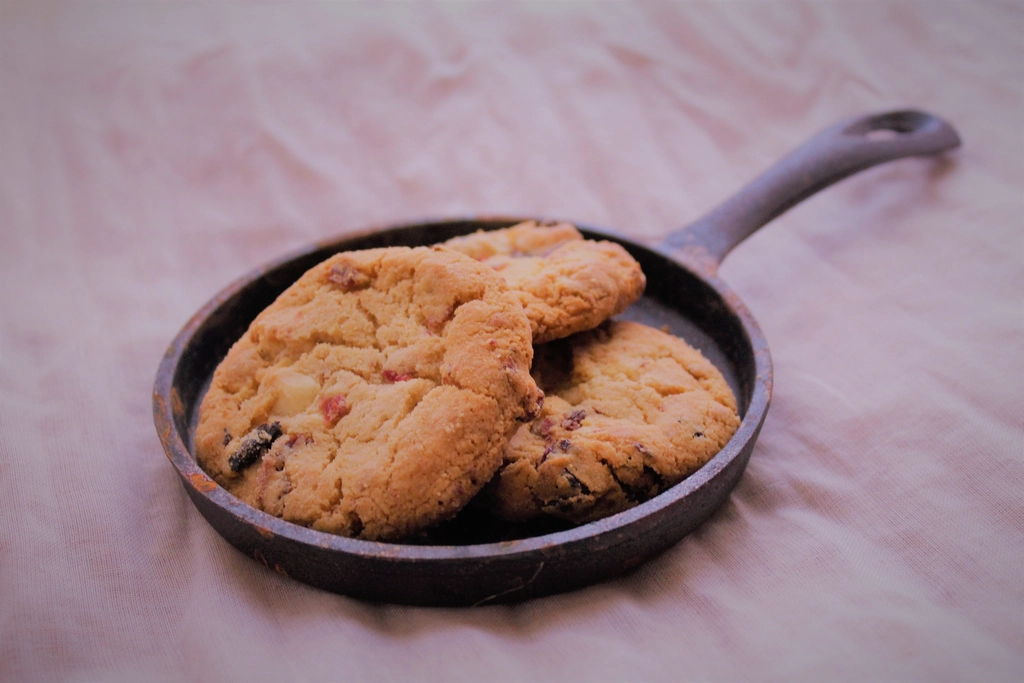
Two ways to shape them. Roll each piece on a floured surface to a quarter inch and cut around a nine-inch pan lid, or press the dough directly into a greased and floured nine-inch cake pan or a cast iron skillet with floured fingers. Pressing is faster and more forgiving; rolling gives a more even layer.
Bake at 400 degrees for eight to ten minutes. The layers are done when the edges have just darkened and the centre springs back but still looks underbaked. They will be firm and slightly dry, and they will look like a mistake. That is correct.
Cool them flat on a rack. Stacking warm layers traps steam and makes the bottoms gummy, and a layer that has been bent while warm will crack later. Six layers out of two pans takes about forty minutes with the rotation. The scraps from cutting are the cook’s, and they are the best evidence of how dry these are supposed to be.
Dried apples, and why fresh ones fail
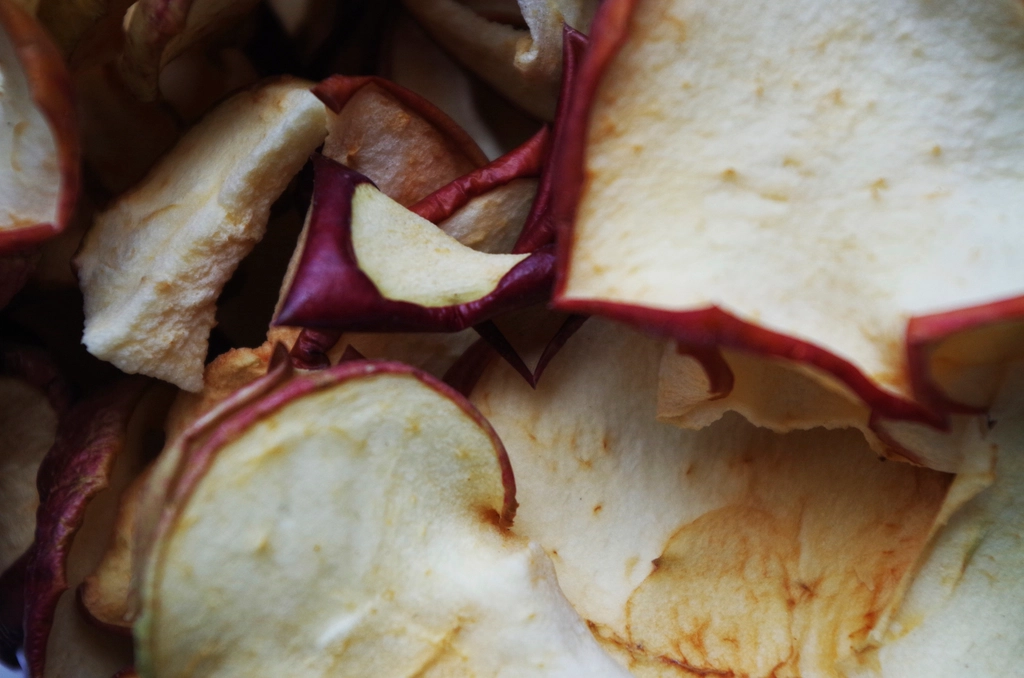
Fresh apples are roughly eighty-five percent water, and cooked down they give up almost all of it. That produces a filling that is loose, pale and mild, and it floods the layers instead of feeding them. It also thins as it sits, so the cake slumps and the bottom layer goes to mush overnight.
Dried apples come back differently. Soaked and simmered, they rehydrate to a thick, tacky, concentrated pulp with real apple flavour and enough body to hold its position between layers. The dehydration has already concentrated the sugars and the acid, which is why the filling tastes stronger than the fruit it came from.
A pound of dried apple rings, covered with water and simmered forty-five minutes, mashed with brown sugar, cinnamon, allspice, a pinch of clove and a pinch of salt, gives enough filling for six layers. Aim for the consistency of thick apple butter that mounds on a spoon. Most dried apples sold in supermarkets are treated with sulfites to keep their colour, which is worth knowing for anyone in the house with a sulfite sensitivity; unsulfured rings are darker, taste more like apple, and are sold in most natural food aisles.
An apple stack cake recipe, layer by layer
- Simmer a pound of dried apples in water to cover, 40 to 45 minutes, until completely soft. Drain, keeping the liquid.
- Mash the apples with three quarters of a cup of brown sugar, two teaspoons of cinnamon, half a teaspoon of allspice, a pinch of clove and a quarter teaspoon of salt. Add back soaking liquid a spoonful at a time until it mounds thickly. Cool completely.
- Cream half a cup of butter with half a cup of sugar. Beat in one cup of sorghum syrup and two eggs.
- Whisk five cups of flour with a teaspoon of baking soda, a teaspoon of baking powder, two teaspoons of ground ginger and a teaspoon of salt.
- Add the dry ingredients to the wet alternately with three quarters of a cup of buttermilk, mixing only until it comes together. The dough will be stiff.
- Divide into six equal pieces, wrap, and chill 30 minutes.
- Roll or press each piece into a nine-inch round, a quarter inch thick, in a greased and floured pan.
- Bake at 400 degrees, 8 to 10 minutes each. Cool flat on a rack.
- Stack, spreading about two thirds of a cup of filling over each layer and leaving the top layer bare.
- Cover with a plate or an inverted bowl and leave at cool room temperature 12 to 24 hours before cutting.
Assembly, and the weight on top
Work on the plate the cake will be served from, because it cannot be moved afterward without cracking. Spread the filling to within a quarter inch of the edge; it will spread the rest of the way under the weight of what comes above. Leave the top layer plain, dusted with a little powdered sugar at serving if anything at all.
Some households put a light weight on top, a plate with a can on it, to press the layers into contact. It is not required and it can be overdone: enough weight to squeeze filling out the sides has taken moisture away from where it was supposed to go. A plate resting on the top layer is plenty.
Cover it, loosely. A cake left open dries out at the edges while the middle softens, and the outer inch stays hard. A large inverted bowl or a cake dome is the traditional arrangement and it also keeps the surface from getting sticky.
The night in the pantry, hour by hour
| Time after assembly | What the cake is doing | Verdict |
|---|---|---|
| 1 hour | Layers still dry, filling still distinct | Do not cut it |
| 6 hours | Surfaces softening, edges still firm | Getting there |
| 12 hours | Layers moist through, boundaries blurring | Servable |
| 24 hours | Uniform crumb, spice fully bloomed | The intended cake |
| 48 to 72 hours | Denser still, apple flavour deeper | Many cooks prefer it here |
Cut it with a long thin knife wiped between slices, straight down rather than sawing. Slices should be narrow. This is a dense cake and a two-inch wedge is a great deal of it. It goes with coffee, with unsweetened whipped cream, or with nothing, which is how it is usually served in the places it comes from.
Storing it, and the line the counter rest depends on
A twelve to twenty-four hour rest at cool room temperature is safe here for a specific reason, and it is worth understanding rather than copying. The filling is a cooked, sugar-heavy, acidic dried fruit preserve with little free water available, and the layers are a baked flour product. Neither one is a hospitable place for bacteria at room temperature for a day.
Change either variable and the rule changes with it. A filling made from fresh apples, a filling with cream or custard in it, or any addition of dairy frosting means the cake belongs in the refrigerator and the long counter rest is off the table. A cool pantry below about seventy degrees is what the traditional method assumes; a warm kitchen in August is not the same thing, and that cake should rest covered in the refrigerator and come back to room temperature before serving.
Once cut, it keeps four or five days well wrapped at room temperature and about a week refrigerated, though refrigeration firms it up and it needs an hour out before serving. It also freezes whole or in slices for three months, wrapped tightly, and thaws better than most cakes because there is so little air in the crumb. Anyone keeping a file of recipes handed down in a family will recognise the pattern: the ones that survive are the ones that keep.
Where it goes wrong
Layers baked soft. A layer taken out at six minutes has no absorbency and turns to paste. Underbaked here means ruined, not tender.
Fresh apple filling. Too wet, too thin, too mild. It floods the bottom layer and the cake sits in a puddle.
Filling cooked too far. A stiff, dry apple butter has nothing to give the layers overnight, and the cake stays six separate rounds.
Cut too early. The most common failure by a wide margin, and it makes people think they do not like the cake.
Blackstrap molasses. Bitter and overpowering. Sorghum first, light molasses second, nothing else.
Uneven layers. Divide the dough by weight. Guessing produces one burnt layer and one raw one out of every six.
Frequently Asked Questions
Where do I find sorghum syrup?
Farm stands and country stores across the mountain South carry it in autumn, and several small mills sell by mail year round. Failing that, use light or full-flavour molasses at the same volume and expect a slightly darker, less tangy cake. Avoid blackstrap entirely.
Can I use a spice cake mix for the layers?
It will not work, and the reason is structural rather than snobbery. A mix produces an open, aerated crumb that dissolves under a wet filling. The stiff, close-grained layer is the part of this cake doing the actual work.
How many layers should it have?
Six is a normal home count and this recipe is built for it. Old accounts describe anywhere from five to a dozen, and more layers means each one is thinner and the cake softens faster. Twelve is a project, not an improvement.
Can I make it with dried peaches?
Yes, and dried peach stack cake is made in the same region and handled identically. Peaches are sweeter and less acidic, so cut the sugar in the filling by a quarter and add a squeeze of lemon. Everything else stays the same, including the way the fruit is cooked down before it goes anywhere near the layers.
Why is my cake dry in the middle?
Not enough filling per layer, or filling spread only to the centre. Two thirds of a cup per layer, taken almost to the edge, is the amount that gets moisture where it needs to go. A thin scrape looks tidy and produces a dry cake.
Bake it on a Friday, leave it under a bowl on the counter, and forget about it until Saturday afternoon. The waiting is not a garnish on the recipe. It is most of what the recipe is, and it is also the part that requires nothing from the cook except leaving the room. If dried fruit and long keeping interest you, our other apple desserts take a shorter route to a similar place.