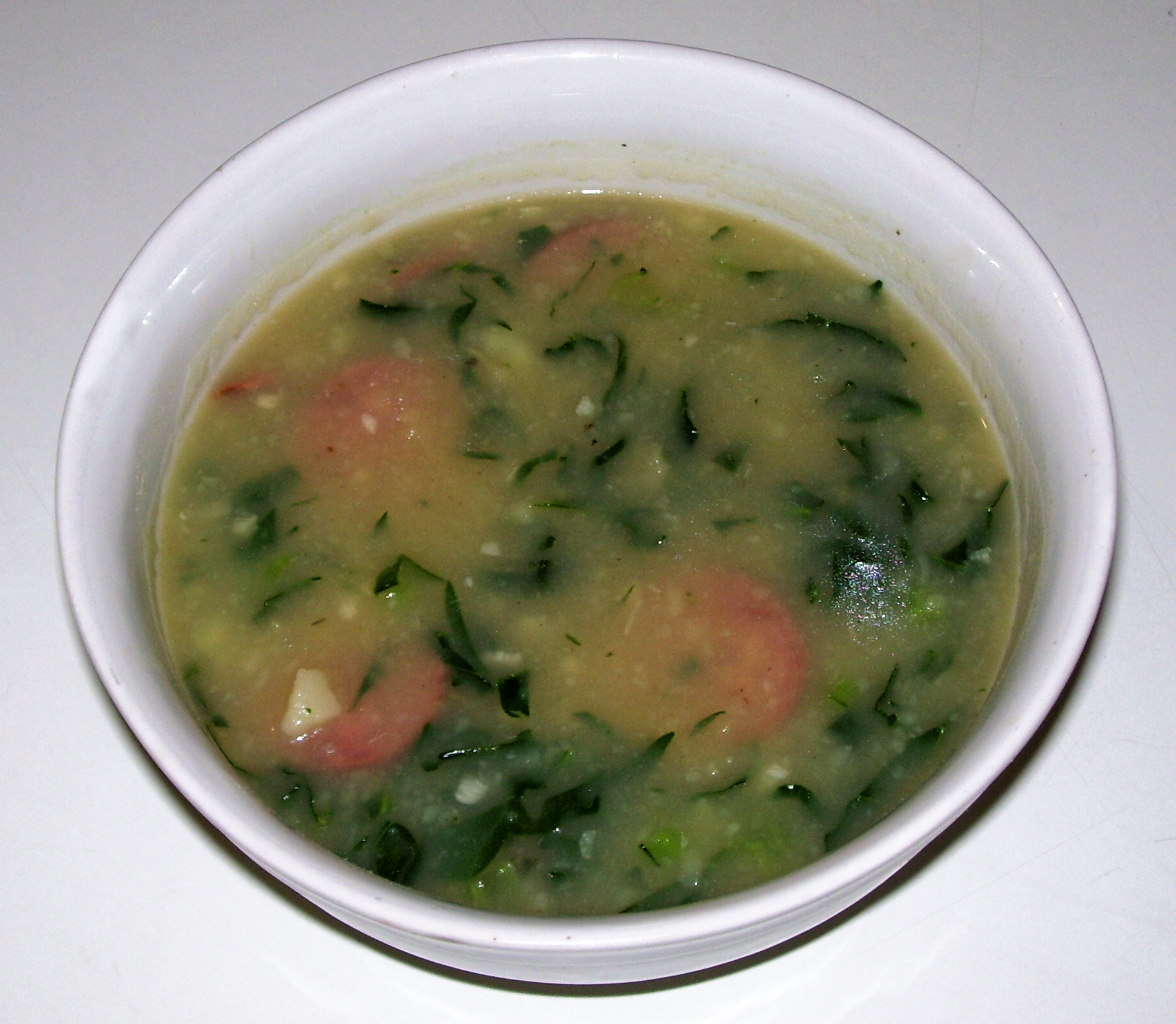
Three things go into the pot: potatoes, onions, water. Two more arrive at the end: a handful of greens cut into ribbons as thin as thread, and a sausage sliced into coins. The whole shopping list costs less than a sandwich and it feeds six people, which is the reason this soup exists and the reason it never left the weeknight rotation in northern Portugal.
It is also a soup with very little room to hide. There is no stock, no cream, no roux and no long list of aromatics, so every decision shows up in the bowl. The two that matter most are how thin the greens are cut and whether the sausage was cooked in the pot or beside it.
What follows is the version cooked in the north, the substitutions an American produce aisle actually allows, and the twenty minutes of real work that separate a good bowl from a green potato soup.
- Serves: six as a first course, four as dinner with bread
- Time: 45 minutes, about 20 of them hands on
- The five ingredients: potato, onion, greens, sausage, olive oil
- The cut: greens shredded to under an eighth of an inch, and cut last
- The thickener: the potato itself, mashed. No flour, no cream, no stock cube
- What to leave out: carrot, celery, bay leaf, cheese, and every herb
The north claims it, and the claim is tradition rather than record
Ask in Portugal where the soup comes from and the answer is the Minho, the green rain-soaked province in the far northwest above Porto. That attribution is repeated in cookbooks, on restaurant menus and by families across the country, and it fits the agriculture: the cabbage it is built on grows in kitchen gardens all over that region.
What does not exist is a document that settles it. The dish is peasant cooking, which by definition leaves no paper, and the earliest printed recipes are far younger than the practice they describe. Treat the Minho origin as a strong and consistent tradition rather than as a fact anyone has proved, and treat any story that names an inventor or a year with more suspicion still.
Its national standing is not in dispute. It turns up at weddings, at street festivals in June, at the end of long nights, and on menus in every region, which puts it near the centre of Portuguese cooking whatever its birthplace. The version served in Lisbon is thicker and smoother than the one served in the north. Both are called the same thing.
Couve galega, and what a supermarket can put in its place
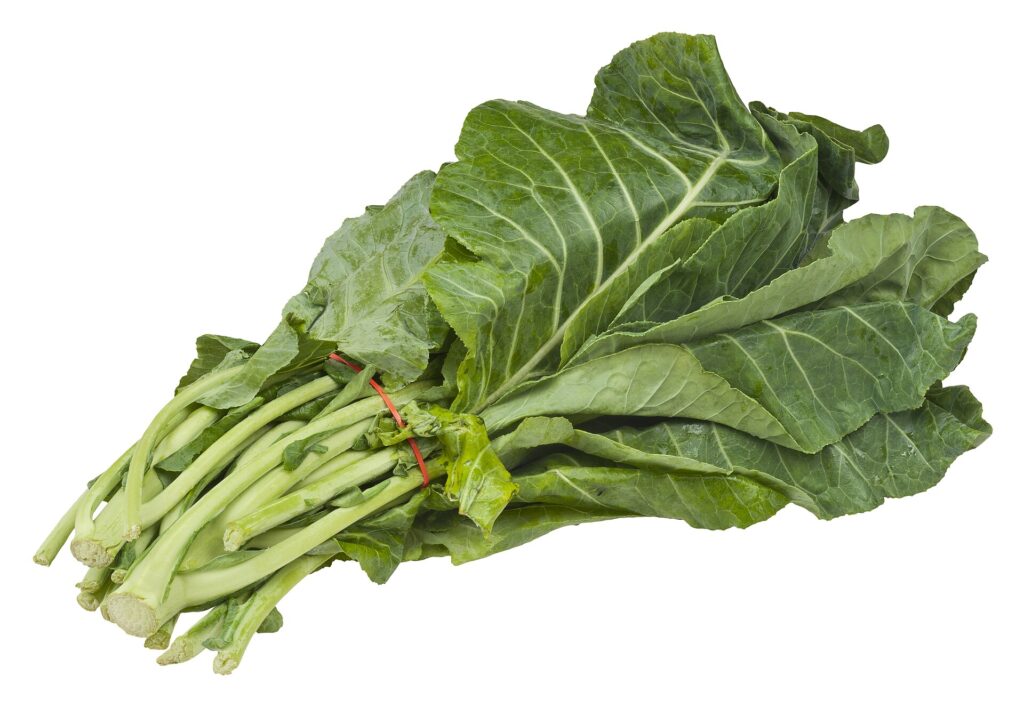
The traditional green is couve galega, a tall loose-leafed cabbage grown on a thick stalk, with flat blue-green leaves and no head at all. It is mild, faintly sweet, and it holds its colour and its bite in hot liquid for a few minutes, which is exactly what the soup needs.
No American supermarket stocks it under that name. Three things stand in, and they are not equivalent.
| Green | Behaviour in the pot | Cut | Time in the liquid |
|---|---|---|---|
| Collards | Closest match, sturdy, mild, holds colour | Stems out, rolled and shaved | 4 to 5 minutes |
| Lacinato kale | Darker, slightly bitter, holds shape well | Stems out, rolled and shaved | 3 to 4 minutes |
| Curly kale | Frilly edges trap broth, ribbons less clean | Harder to shave evenly | 4 to 5 minutes |
Collards are the honest first choice and the one most likely to fool a Portuguese cook. Anyone who already keeps them in the house for the long-simmered Southern treatment will find the handling identical up to the point where the cooking time drops from two hours to four minutes.
Why the greens are cut like thread
The width of the ribbon is not decoration. A thin shred cooks through in three or four minutes, which is short enough that the chlorophyll has not had time to break down and the green stays green. A wide ribbon needs eight or ten, and by then the colour has gone olive and the flavour has gone sulfurous.
Cut the stems out first by folding each leaf in half along the rib and slicing it away. Stack six or eight leaves, roll the stack into a tight cigar, and shave across it with the longest sharp knife in the drawer. The target is under an eighth of an inch, and in Portugal it is often thinner than that, cut on a hand slicer sold for exactly this purpose.
Cut them last, after the potatoes are mashed and the pot is ready. Shredded greens oxidise fast and start to smell cabbagey within twenty minutes on the board. That smell is the single reason people think they dislike this soup, and it is entirely avoidable.
The potato does the thickening
Two pounds of potato, one large onion, three garlic cloves and about ten cups of water, salted, simmered until the potato falls apart under a spoon. That is the base, and nothing else goes into it. No stock, because the potato and onion make their own; no bay leaf, because it puts a flavour where a plain background is wanted.
Use a floury potato. A russet breaks down and thickens the liquid on its own. A waxy potato stays in lumps and produces a watery soup with pieces in it, which is a different and much less interesting bowl.
Mash rather than blend, or blend briefly and accept the consequences. A stick blender run for ten seconds gives a smooth, slightly rustic body. Run for a minute and the starch granules rupture and the soup turns gluey and stretchy, the same failure that ruins mashed potato. A hand masher cannot make that mistake and is the safer tool.
Chourico, chorizo, and linguica are three different sausages

The Portuguese sausage is chourico: coarse pork, garlic, wine and paprika, smoked and cured, firm enough to slice into coins. It is the one the soup was built around and it is stocked in Portuguese and Brazilian groceries and in a fair number of ordinary supermarkets.
Spanish chorizo is the closest substitute, though it usually carries more pimenton and reads smokier and sweeter. Mexican chorizo is not a substitute at all: it is raw, soft, and crumbles rather than slicing, and it will turn the pot orange and greasy. Linguica is milder and thinner and is a reasonable third choice if the sausage is going to be the quiet element.
Whichever one goes in, cook it in a separate dry pan, not in the soup. Sliced into quarter-inch coins over medium heat, it renders its paprika-stained fat, crisps at the edges, and can be lifted out with the fat left behind. Sausage simmered in the pot gives up the same fat into the broth, which clouds it, dulls the green, and coats the mouth. Add the coins to each bowl at the end.
A caldo verde recipe for six
- Peel and chop two pounds of russet potatoes and one large onion. Smash three garlic cloves.
- Warm three tablespoons of olive oil in a large pot over medium heat. Cook the onion and garlic eight minutes, until soft and not coloured.
- Add the potato, ten cups of water and two teaspoons of salt. Bring to a boil, then simmer 20 to 25 minutes, until the potato collapses under a spoon.
- While that goes, slice the sausage into coins and brown them in a dry pan, four minutes. Set them aside and leave the rendered fat in the pan.
- Strip the stems from twelve ounces of collards or kale, stack, roll and shave into the thinnest ribbons your knife allows. Do this now, not earlier.
- Mash the pot with a hand masher until the soup is thick and mostly smooth. Taste for salt, and remember the sausage is salty.
- Bring the pot back to a strong simmer. Add the greens all at once and stir.
- Cook four minutes, uncovered. Taste a ribbon: it should be tender with a little resistance, and still bright green.
- Take the pot off the heat immediately. Greens left in hot soup keep cooking and will go grey in ten minutes.
- Ladle into bowls, drop the sausage coins on top, and finish each bowl with a hard pour of raw olive oil.
The olive oil is an ingredient, not a garnish
The finish is a genuine tablespoon per bowl of good raw olive oil, poured in a circle over the surface. It is not a drizzle for the photograph. The soup underneath is deliberately lean, and the oil supplies the fat, the aroma and most of what makes the bowl satisfying rather than thin.
Use something with character, since it is going in uncooked and it is the loudest flavour on the table after the sausage. Portuguese oils tend to be robust and slightly peppery, which suits it. The oil used to soften the onion at the start can be ordinary; this one should not be.
Bread is not optional either. Broa, the dense corn and rye bread of the north, is the traditional partner, and any coarse country loaf does the job. A glass of vinho verde, the young slightly fizzy white from the same region, is what gets poured alongside it there.
When it is actually eaten there
The portion is smaller than an American soup course. It arrives first, in a shallow bowl, before whatever is grilled or fried afterward, and it is meant to take the edge off rather than to be the meal. Six servings from this pot is the Portuguese count; four is the American one.
It also has a place late at night. It is the standard thing served at the June street festivals in Porto and Lisbon, ladled out of enormous pots at two in the morning alongside grilled sardines, and it is what turns up at the end of weddings for the same reason. Cheap, hot, and easy to make in quantity.
None of that stops it working as dinner. Serve it in deeper bowls with more sausage, a second potato, and enough bread on the table, and it holds up on its own. That is how it is eaten in a lot of houses in winter, whatever the restaurant convention says.
Two variations that are still the same soup
The first is the southern version, smoother and thicker, blended rather than mashed and often enriched with more oil in the base. It is common in Lisbon restaurants and it is a legitimate way to make it. What it loses is the slightly rough body that makes the northern bowl feel like food rather than puree.
The second swaps the cabbage for turnip tops, which are sharper and more mustardy and want a minute less in the pot. Households across the north use whatever the garden is producing, and turnip greens in early spring are as traditional as the cabbage. The soup goes darker and gains a bitter edge that the olive oil balances.
What is not a variation is adding cream, cheese, bacon or herbs. Each one produces a decent bowl of soup and none of them produces this one, in the same way that a bowl of green potato soup with a bay leaf in it is simply a different recipe wearing the name.
Where it goes wrong
The greens go in too early. Ten minutes in the pot and the colour is gone and the smell has turned. Four minutes, then off the heat.
The ribbons are too wide. Quarter-inch strips need twice the cooking time and the soup cannot survive it. Thin cutting is the technique of the dish.
Waxy potatoes. They will not thicken. The result is greens floating in salted water with potato chunks at the bottom.
Sausage simmered in the pot. Cloudy broth, dulled colour, greasy mouthfeel. Brown it separately every time.
Blended to death. Ten seconds with a stick blender, or a masher. A minute in a countertop blender produces glue.
Stock instead of water. Chicken stock buries the potato and the onion, which are supposed to be audible. Plain water is the correct choice and is not a compromise. The same restraint runs through most good short-list soups.
Keeping it, and reheating without ruining it
The base keeps four days and freezes well. The finished soup does not, because reheated greens lose colour and texture on the second pass. Cook the potato base ahead, refrigerate it, and add freshly cut greens to the portion being reheated. Five minutes of work buys back the whole dish.
Cool it properly. A deep pot of starchy soup holds heat for hours, so ladle it into shallow containers rather than putting the whole pot in the refrigerator, and get it cold within two hours of coming off the stove. Reheat to a full simmer, not to warm, and do not leave a covered pot cooling on an unlit burner overnight.
The sausage keeps separately in the refrigerator for several days and crisps again in a dry pan in a minute. Storing it out of the soup is the same decision as cooking it out of the soup, for the same reasons.
Frequently Asked Questions
Can I make it without sausage?
Yes, and it stays recognisable, because the potato, the greens and the oil carry the dish. Increase the finishing olive oil, add a little smoked paprika to the onion for the missing note, and salt slightly harder, since the sausage was doing some of that work.
Is this the same soup as a Galician caldo?
They are relatives rather than the same dish. The Galician version across the border is usually built on beans and a fattier cut of pork and is a heavier bowl. The Portuguese one is thinner, greener and faster, and the shredded cabbage is its defining feature.
How thin do the greens really need to be?
Under an eighth of an inch. If the ribbons look like fettuccine, they are too wide. A very sharp knife and a tightly rolled stack of leaves gets most people there on the second try, and a mandoline with a guard does it in seconds.
Can I use a blender for the potato?
Briefly and carefully. A stick blender for about ten seconds is fine. A high-speed countertop blender is the wrong tool entirely for cooked potato and will produce a gummy texture that cannot be corrected.
What can I do with the collard stems?
Slice them thin and cook them with the onion at the start, where twenty-five minutes in the pot softens them completely and they disappear into the mash. That is better than throwing away a third of the bunch.
Make it once with the greens cut properly and once with them cut the way a hurried cook cuts them, and there is no need to argue the point further. Everything else in the pot is potato, water and patience.