Chimichurri run through a food processor comes out a uniform, slightly foamy green paste, and it is not the same sauce as one made with a knife. The blade bruises the parsley and oregano, releasing chlorophyll and moisture in a way that dulls the herbs’ brightness and turns the whole thing closer to a pesto than to what a chimichurri is supposed to be.
A properly chopped chimichurri stays loose, with distinct flecks of herb suspended in oil and vinegar rather than blended into it, and that texture is not a stylistic preference. It changes how the sauce sits on food, how long it keeps its color, and how sharp the vinegar tastes against the herbs.
What follows is the sauce built the traditional way, by hand with a knife, the rest time it needs before it tastes right, how long it actually keeps, and the case for serving it next to a roast turkey rather than only alongside steak, where most people encounter it first.
- Core ingredients: parsley, dried oregano, garlic, red wine vinegar, olive oil
- Method: chopped by hand, never blended or processed
- Rest time: at least 30 minutes, better after 2 hours
- Shelf life: about a week refrigerated, though the color fades after day three
- Traditional use: grilled beef in Argentina and Uruguay
- The case here: it cuts through rich roasted poultry just as well as it cuts through steak
A chimichurri recipe that starts and ends with a knife
Finely chop a large bunch of flat-leaf parsley, stems removed, along with four cloves of garlic, until both are close to a uniform fine mince but still clearly made of distinct pieces rather than a paste. Combine with two tablespoons of dried oregano, a half teaspoon of red pepper flakes, a half cup of red wine vinegar, and three-quarters of a cup of olive oil, along with salt to taste.
Stir rather than whisk, since the goal is to combine the ingredients without emulsifying them into a single smooth mixture. The finished sauce should look loose and slightly separated, with oil pooling at the surface and vinegar settling toward the bottom, which is exactly the texture that makes it easy to spoon over meat without the sauce clinging as a heavy coating.
Chopping versus blending, and why the knife wins
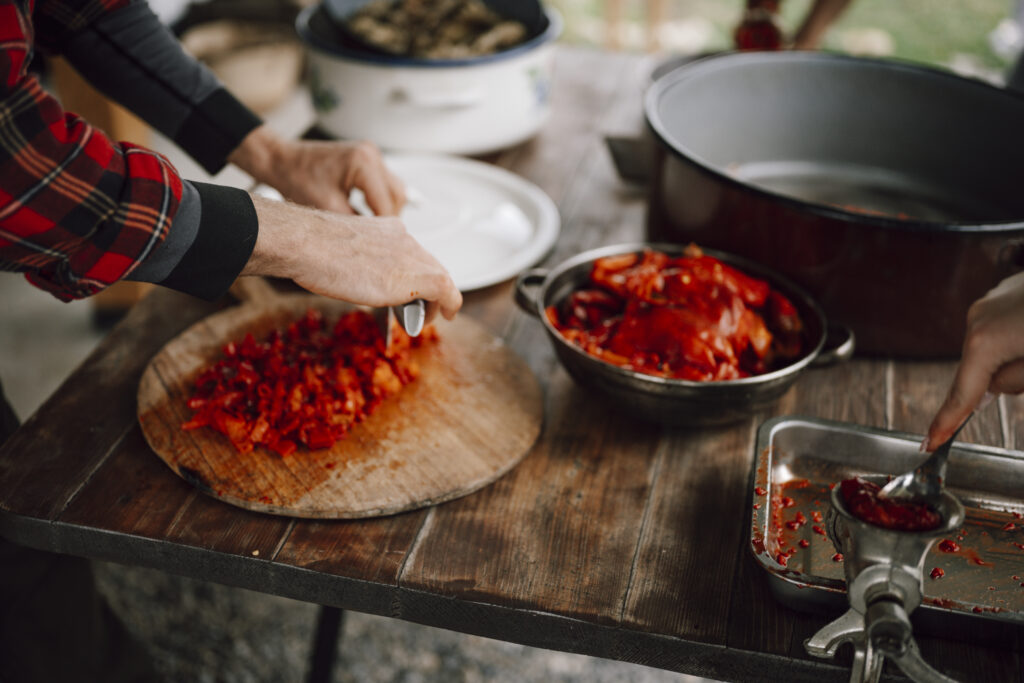
A food processor’s blade moves fast enough to shear plant cell walls open aggressively, releasing chlorophyll, moisture, and bitter compounds that a slower knife cut releases far less of. The result is a sauce that oxidizes and browns faster, tastes more bitter, and loses the bright, grassy top note that makes fresh parsley worth using in the first place.
A hand-chopped chimichurri also keeps its texture distinct once spooned over hot meat, staying as small, separate pieces of herb rather than melting into a uniform green film the way a processed version tends to when it meets residual heat from a just-off-the-grill steak or a freshly carved turkey.
Parsley and oregano: fresh for one, dried for the other
Fresh flat-leaf parsley is essential here; curly parsley works in a pinch but carries a more bitter, less rounded flavor and a tougher texture that does not soften the same way under the acid in the sauce. Oregano, somewhat counterintuitively, is traditionally used dried rather than fresh in most Argentine versions, since dried oregano has a more concentrated, slightly muskier flavor that holds up better against the vinegar than fresh oregano’s brighter, more delicate character.
Using fresh oregano instead is not wrong, simply a different, milder result, and it should be used in a larger quantity than the dried amount called for to compensate for its weaker concentration.
The vinegar, and why red wine is the traditional choice
Red wine vinegar’s moderate acidity and slightly fruity edge is the standard choice across most Argentine and Uruguayan households, striking a balance between sharpness and roundness that a harsher white vinegar or a milder rice vinegar does not replicate as well. The vinegar is doing real work here beyond seasoning: it is what keeps the parsley’s color from fading as quickly and gives the sauce enough acidity to cut through rich, fatty meat.
A quarter cup of water is sometimes added alongside the vinegar in some regional versions to soften the sharpness slightly, which is worth trying for anyone who finds the full-strength version too aggressive on its own.
Why the sauce needs to rest before it tastes right
A chimichurri tasted the moment it is mixed together tastes disjointed, with the raw garlic sharp and separate from the vinegar and herbs rather than integrated into a single flavor. Resting at room temperature for at least thirty minutes allows the garlic to mellow and the flavors to meld, and a rest of two hours or more produces a noticeably rounder, more cohesive sauce.
This is one of the few fresh herb sauces that genuinely benefits from sitting out rather than being served immediately, and it is worth building the rest time into the schedule of a meal rather than treating chimichurri as a last-minute garnish thrown together right before serving.
How long it actually keeps, and what changes as it ages
| Time refrigerated | Color | Flavor |
|---|---|---|
| Day 1 to 2 | Bright green | Sharp, garlic still assertive |
| Day 3 to 4 | Starting to dull | Rounder, garlic mellowed further |
| Day 5 to 7 | Olive-drab | Still safe and flavorful, less visually appealing |
The sauce remains safe to eat throughout the week refrigerated in a sealed container, since the high acid and oil content are not hospitable to most spoilage organisms, but the color shift is real and worth knowing about if serving it to guests, since a duller green sauce, while perfectly good, looks less appetizing on the plate than a freshly made batch.
Why it belongs next to roast turkey, not only next to steak
Chimichurri’s traditional role is alongside grilled beef, cutting through the fat of a well-marbled cut with sharp acid and bright herb, and that same cutting power works just as effectively against the richness of a roasted turkey, particularly the dark meat and the gravy-soaked stuffing that dominate most holiday plates. A spoonful over sliced turkey breast does something a plain cranberry sauce, built mostly on sweetness, cannot: it adds sharpness and herbaceousness rather than more sugar to an already rich plate.
Its texture also works in favor of a holiday table specifically, since it needs no reheating and no last-minute attention, sitting ready in a bowl at room temperature while every other dish on the table is competing for stovetop and oven space.
Adjusting the heat and the acidity to taste
The half teaspoon of red pepper flakes called for above is a mild, background level of heat rather than a defining feature of the sauce, and it can be increased for anyone wanting a sharper bite or omitted entirely for a milder version served to a mixed table with younger guests. Because the flakes are not blended in, adjusting the quantity does not risk throwing off the sauce’s texture the way it might in a smoother, processed sauce.
Similarly, the vinegar-to-oil ratio can shift slightly toward more vinegar for a sharper sauce meant to cut through something very rich, or slightly toward more oil for a gentler version meant to accompany something already well seasoned on its own.
A small pinch of sugar, while not traditional, is a reasonable adjustment for anyone finding a particular batch of vinegar unusually sharp, rounding out the acidity slightly without meaningfully changing the sauce’s overall character or moving it away from its savory identity.
Where chimichurri comes from, and why Argentina and Uruguay both claim it
Chimichurri’s exact origins are genuinely disputed, with no single documented inventor, and both Argentina and Uruguay treat the sauce as a core part of their own grilling tradition rather than a shared import from one to the other. What is not disputed is its role: a table condiment for asado, the long, slow-grilled beef tradition central to both countries’ food culture, served in a small dish or bottle for diners to spoon over meat as they eat rather than as a sauce cooked into the dish itself.
Countless family versions exist, varying in the ratio of vinegar to oil, whether water is added, and how finely the herbs are chopped, and no single version is considered the definitively correct one. The through-line across all of them is the method: fresh herbs, a sharp vinegar, good oil, and a knife rather than a machine.
Building a full board around it for a holiday table
Beyond turkey, chimichurri holds its own next to a wide range of dishes that might already be on a holiday table: roasted root vegetables, a simple grain salad, or a plate of grilled or roasted sausage served as an appetizer before the main meal. Its acidity and herbaceousness make it a useful all-purpose sauce for a table already carrying several rich, heavy dishes that could use something sharp to break up the monotony.
A small bowl set out early in the meal, before the turkey itself is carved, also gives guests something to dip bread into while the rest of the meal finishes cooking, extending its usefulness beyond a single course.
Knife technique that makes the chopping faster
Bunching the parsley tightly and using a rocking motion with a large chef’s knife, rather than a straight up-and-down chop, moves through a full bunch faster and more evenly than trying to mince it in small increments. Removing the thicker stems first, which do not break down the same way the leaves do, also speeds the process and avoids tough, fibrous bits in the finished sauce.
Garlic minces faster and more evenly if it is first crushed lightly with the flat of the knife blade to break the clove open, rather than attempting to slice a whole clove into fine pieces from the start. Both techniques together bring the total knife time for a full batch down to well under ten minutes with a little practice.
Frequently Asked Questions
Can chimichurri be made ahead for a holiday meal?
Yes, and it should be. Made a day or two ahead and refrigerated, it actually tastes better than a version made the same day, since the extra time lets the flavors meld further.
Is there a green sauce and a red sauce version?
Yes, a red variation called chimichurri rojo adds paprika and sometimes tomato paste to the same base, giving a deeper color and a smokier flavor. The green version described here is the more common of the two.
Can dried parsley be used instead of fresh?
Not successfully. Dried parsley lacks the moisture and brightness that define this sauce, and there is no good substitute for fresh parsley here the way dried oregano can substitute reasonably well for fresh.
Why does my chimichurri taste bitter?
Most likely it was processed in a blender or food processor rather than chopped by hand, which bruises the herbs and releases more bitter compounds. A second likely cause is curly parsley used in place of flat-leaf.
Is it safe to leave chimichurri out at room temperature during a meal?
For the duration of a meal, a few hours, it is fine given its high acid and oil content. For longer than that, refrigerate it and bring it back out closer to serving time.
Does the olive oil need to be a particular quality?
A good, everyday olive oil is sufficient, since the sauce’s flavor comes primarily from the herbs, garlic, and vinegar rather than the oil itself. Reserving an expensive finishing oil for this application is not necessary the way it might be for a dish where oil is the star.
The knife work takes an extra five minutes over dumping everything into a food processor, and that five minutes is the entire difference between a sauce that tastes like an afterthought and one that holds its own against a plate as rich as a holiday turkey dinner.