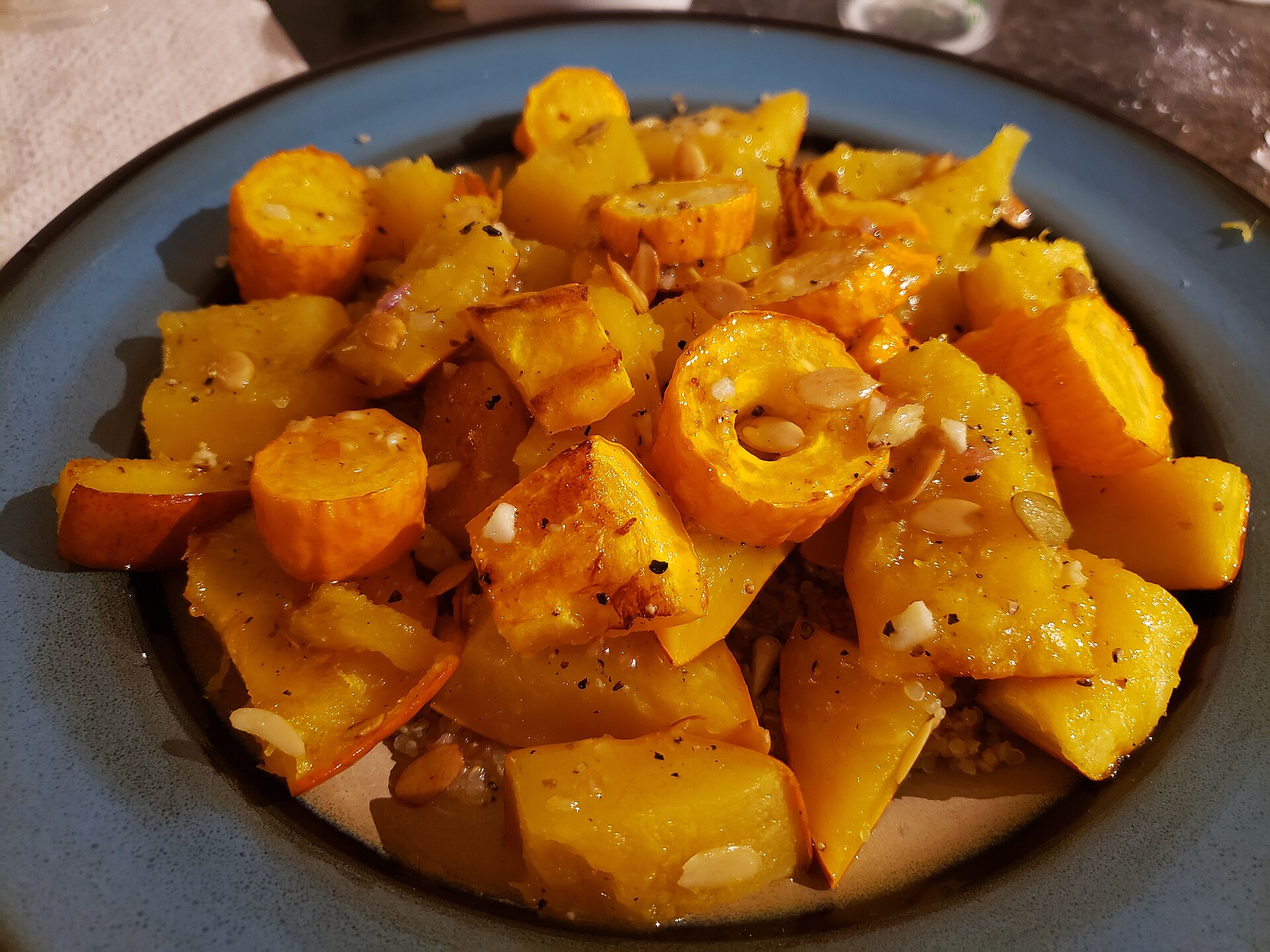
Three squashes on the same sheet pan, cut the same size, same oil, same oven, forty minutes. One comes out glossy and slumping, sweet enough to eat like candy. One comes out firm at the edge with skin you can chew. One comes out matte and floury and tastes like a roasted chestnut. They are not versions of the same vegetable.
Which is why the same treatment gives three different results and why the recipe that made butternut sing does nothing for kabocha. The variable underneath all of it is water: how much is in the flesh, how fast it leaves, and what is left behind when it does.
Nine pairings that hold up, three that get repeated in print every autumn and do not work, and the reason each one lands where it does.
- Butternut: wettest and sweetest. Wants acid, salt and heat, not more sugar
- Delicata: thinnest skin, fastest cook, least starch. Wants sharpness
- Kabocha: driest and starchiest. Wants fat and umami and a little liquid
- Roasting: 425 for butternut and delicata, 400 and longer for kabocha
- Skin: edible on delicata and kabocha, not worth eating on butternut
- The three that fail: maple syrup, baking spice without salt, and cream
Three squashes measured the same way
They are not close relatives, despite sharing a shelf. Butternut and its cousins are one species, delicata belongs to the same group as summer squash and pumpkins, and kabocha is a third. That distance shows up in the pan.
| Butternut | Delicata | Kabocha | |
|---|---|---|---|
| Moisture | High | Moderate | Low |
| Sweetness | High | Moderate to high | Moderate |
| Starch | Moderate | Low | High |
| Skin | Peel it | Eat it | Eat it once cooked |
| Roast time, 1-inch pieces | 30 to 35 min at 425 | 22 to 25 min at 425 | 40 to 45 min at 400 |
| Texture when done | Silky, slumping | Tender, holds shape | Dry, floury, dense |
| Best method | Roast hard or puree | Roast in rings | Simmer, steam or roast |
Every pairing below follows from that table. There is no mystery to it: a wet sweet flesh and a dry starchy one need opposite support, and the ingredient that rescues one will bury the other.
Water is the variable that decides the method
A high-moisture squash in a hot oven spends most of its time boiling in its own steam. Only once the surface dries does browning start, which is why butternut needs a high temperature, real space on the pan, and a full half hour before anything interesting happens at the edges.
A low-moisture squash has the opposite problem. Kabocha will go from firm to dry and chalky without ever passing through a stage that could be called succulent, so it wants either a lower oven and more time, or a wet method entirely: a simmer in dashi, a braise in coconut milk, a steam.
Delicata sits between them and cooks fastest because it is the smallest and thinnest walled. Cut into half-moons with the skin on, it is the only one of the three that is reliably good in under half an hour, which is most of the argument for buying it.
What goes with butternut squash, and what does not
The flesh is sweet and it gets sweeter as it roasts, so every good pairing is a counterweight. Salt, acid, bitterness and chile heat all work. Another sweet thing does not, and that is the source of most of the disappointing butternut on the internet.
Brown butter, sage and parmesan. The oldest pairing and still the best argued. The butter contributes browned milk solids, the sage a resinous bitterness, the cheese salt and glutamate. Three counterweights at once.
Harissa, yogurt and mint. Toss the roasted cubes in harissa loosened with oil, spoon them over thick yogurt, and scatter mint. Heat and sour dairy against sweet flesh, and it takes four minutes once the pan is out.
Anchovy, garlic and chile flakes. Melt two anchovy fillets into olive oil with sliced garlic, pour it over the hot roasted squash, and finish with lemon. The anchovy disappears and leaves salt and depth behind it. This is the pairing people are most reluctant to try and most surprised by.
Delicata wants sharpness and speed
Delicata has less starch than the other two, which means it never gets floury and never gets truly creamy either. It stays somewhere in the middle, tender and slightly toothsome, and its skin is thin enough to eat, which changes what it is good for: rings and half-moons that stay intact on a plate rather than puree.
Sherry vinegar and shallot, applied hot. Slice a shallot paper thin, cover it with sherry vinegar and salt while the squash roasts, and spoon the whole thing over the rings the moment they come out. Hot squash absorbs the acid instead of sitting in it.
Pecorino and coarse black pepper. Sharp sheep’s milk cheese grated over hot rings, then enough pepper to see. The salt and the pepper heat do all the work and there are two ingredients.
Gochujang and lime. A tablespoon of gochujang thinned with lime juice and a little oil, brushed on for the last five minutes of roasting. It caramelises slightly and the lime keeps it from reading as sweet. This one turns a side dish into the interesting part of the plate.
Kabocha wants fat and umami
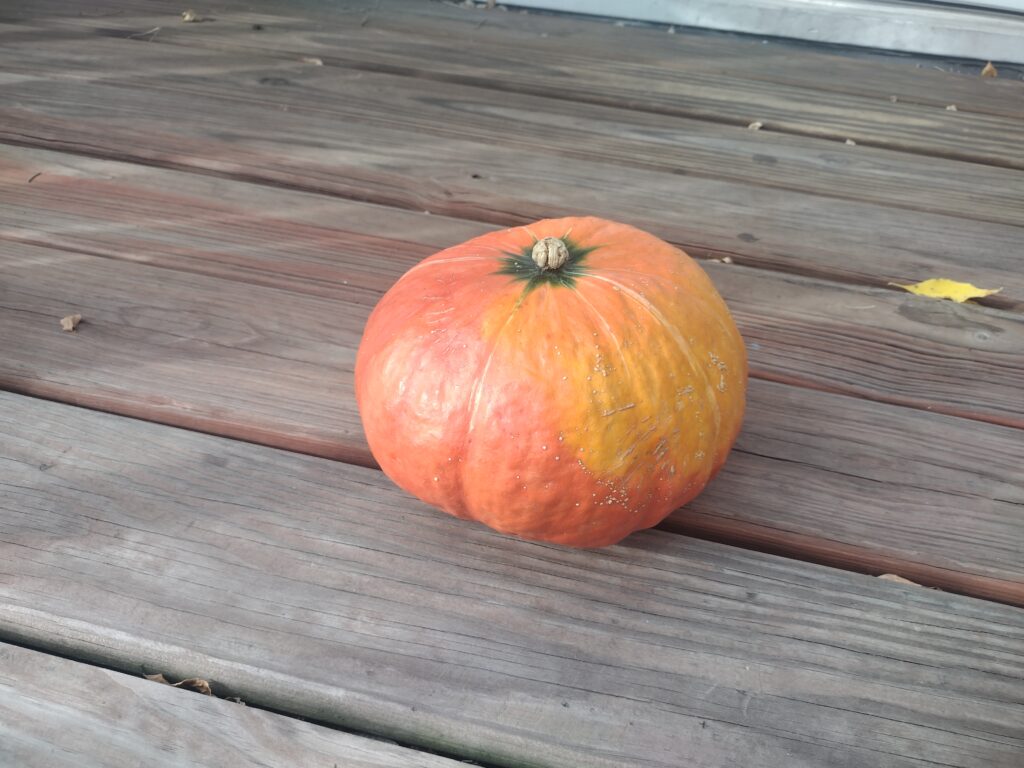
Kabocha is dry, dense and faintly chestnut-like, and its problem is never excess sweetness. It is that the flesh has nowhere near enough moisture or fat of its own, so it can taste austere unless something is added. Japanese cooking has solved this repeatedly and the solutions travel.
Dashi, soy and mirin. Simmered gently in a shallow pan of seasoned dashi until a skewer goes through, then cooled in the liquid, which is when the flavour actually goes in. Skin on, cut side up, twenty minutes. It is eaten warm or at room temperature.
Coconut milk, red curry paste and fish sauce. The fat in coconut milk suits the dry flesh better than butter does, and the fish sauce supplies the salt. Chunks go in for the last fifteen minutes of a curry and hold their shape.
Butter, soy and toasted sesame. Roast the wedges, then toss them while hot with a knob of butter, a teaspoon of soy and a scattering of black sesame. Three ingredients, and the combination of dairy fat and soy is the shortest route to making kabocha taste finished.
The nine, in one place
| Squash | Pairing | What it supplies | Applied |
|---|---|---|---|
| Butternut | Brown butter, sage, parmesan | Fat, bitterness, salt | Over hot roasted cubes |
| Butternut | Harissa, yogurt, mint | Heat, acid, freshness | Squash spooned over yogurt |
| Butternut | Anchovy, garlic, lemon | Salt, umami, acid | Warm oil poured over |
| Delicata | Sherry vinegar, shallot | Sharp acid | On the pan, straight from the oven |
| Delicata | Pecorino, black pepper | Salt, pungency | Grated over hot rings |
| Delicata | Gochujang, lime | Fermented heat, acid | Brushed on, last 5 minutes |
| Kabocha | Dashi, soy, mirin | Umami, salt, moisture | Simmered, cooled in liquid |
| Kabocha | Coconut milk, curry paste | Fat, heat, salt | Simmered 15 minutes |
| Kabocha | Butter, soy, sesame | Fat, salt, toast | Tossed hot after roasting |
Read down the third column and the logic is visible. Butternut gets acid and salt three times. Kabocha gets fat three times. Delicata gets sharpness. Nothing on the list adds sugar to any of them, which is not an accident.
Three pairings repeated everywhere that do not work
Maple syrup on butternut. The squash arrives at the table already sweet, and roasting concentrates it further. Adding syrup produces something closer to a dessert, and worse, it makes the flesh taste one-dimensional, because there is now nothing on the plate that is not sweet. If the aim is a glaze, use something sweet and salty together: soy and honey, or miso and mirin, so the salt keeps pace.
Cinnamon and nutmeg with no counterweight. Baking spice is not wrong on squash, and Moroccan and Indian cooking use it constantly. What makes it work there is that it arrives with salt, chile, onion and acid. Sprinkled onto roasted squash by itself, it triggers the association with pie and the dish stops reading as dinner. Add spice with something savoury or leave it out.
Heavy cream in butternut soup. The flesh is already thick and silky when pureed, so cream adds body where there is plenty and blunts the flavour that was the reason for making the soup. A better ending is stock to loosen it and acid to sharpen it: a splash of cider vinegar or lemon, and a spoonful of yogurt at the table if richness is genuinely wanted. The general principle behind pairing applies here as clearly as anywhere: add what is missing, not more of what is already there.
Roasting them properly, which is not one temperature
Butternut goes at 425 in a single layer with real gaps between pieces. Crowding is the failure that turns a tray into a steamed grey heap, and a pound and a half of cubes wants a full half-sheet pan to itself. Toss with oil and salt, cut side down for the first twenty minutes, then flip.
Delicata goes at the same temperature for less time. Halve lengthwise, scoop the seeds, slice into half-inch half-moons, and the skin holds each piece together. Twenty-two to twenty-five minutes with one flip is usually enough, and it browns faster than it cooks, which is worth watching.
Kabocha wants 400 and more patience, or it wants water. Wedges roasted dry can end up chalky; a quarter cup of water in the pan for the first twenty minutes, then poured off, gives the flesh time to soften before the surface dries. Steaming it and finishing under a broiler is the other reliable route.
Buying them, and the difference curing makes
Winter squash is picked hard and then cured, held warm and dry for a week or two, which toughens the skin for storage and lets some starch convert to sugar. A squash sold straight off the field in early autumn is measurably less sweet than the same squash a month later, which is the main reason a butternut in November beats one in September.
Look at the stem. It should be dry, corky and firmly attached; a soft or missing stem is a route for rot and a sign the squash was cut too green. The skin should be dull rather than glossy, and the fruit should feel heavy for its size. Any soft spot means it goes into the pan this week.
Kabocha is the one most often sold underripe, and an underripe kabocha is watery and bland rather than dry and sweet. Weight is the best available test, and buying from a seller who grows the thing is better still, which is the argument for shopping closer to the field for anything stored.
Where acorn and honeynut fall on the same scale
Two more turn up on the same shelf and both slot neatly into the framework above. Acorn squash is the driest and least sweet of the common varieties, closer to kabocha than to butternut, with fibrous flesh and a ridged shape that makes it awkward to cut into anything but wedges. Treat it as a kabocha with less to give: it needs fat, salt and umami, and it will punish a cook who expects butternut’s sweetness.
Honeynut is a small butternut bred deliberately for concentration, and it behaves like a butternut with everything turned up. Sweeter, denser, deeper orange, thin enough in the skin to eat, and small enough that half a squash is a portion. Every butternut pairing works on it, and the counterweights matter more rather than less, since there is more sugar to balance.
Both roast at 425 like butternut. Acorn takes about thirty-five minutes in wedges and honeynut about twenty-five halved, cut side down. Neither one needs a separate set of rules, which is the practical value of sorting squash by moisture and starch rather than by name.
Cutting one without hurting yourself
Hard winter squash sends people to emergency rooms every autumn, and the mechanism is always the same: a round object rolling on a board while a knife is pushed into it. Fix the rolling and the risk mostly disappears.
Put a damp towel under the cutting board so the board itself cannot slide. Cut both ends off first to create two flat faces, then stand the squash on one of them and cut down through it. Never cut toward your holding hand, and never try to force a knife that has stuck: rock it out and start a new cut rather than levering.
For a very hard kabocha, three minutes in the microwave softens the skin enough to make the first cut safe, and a heavy chef’s knife or a cleaver is a better tool than a long thin blade. Once the squash is halved and the seeds are out, everything after that is straightforward. Whole squash keeps two to three months in a cool dry room; cut squash goes in the refrigerator wrapped and should be used within four days, since the exposed flesh dries and picks up other flavours quickly.
Frequently Asked Questions
Can I substitute one for another in a recipe?
Butternut and kabocha are the closest pair for soups and purees, though kabocha needs more liquid. Delicata is not a substitute for either in anything pureed, since it does not have the starch to give body. Going the other direction, butternut cut into half-moons will not hold its shape the way delicata does.
Do I have to peel butternut squash?
For most uses yes. The skin is thick enough that it stays chewy at the roasting times that suit the flesh, and it will not soften in a puree. A vegetable peeler works once the ends are off and the neck is separated from the bulb.
Are the seeds worth keeping?
Yes, from all three. Rinse off the strings, dry them well, toss with oil and salt, and roast at 350 for twelve to fifteen minutes until they pop and colour. Kabocha seeds are the best of the three and delicata seeds are the smallest and quickest.
Why did my roasted squash come out watery?
Crowded pan, oven too low, or both. Steam trapped between pieces stops browning and leaves the flesh soggy. Use a bigger pan, raise the temperature, and dry the cut surfaces with a towel before oiling them.
Which one is best for soup?
Butternut, because it purees to a silky texture without help and needs no starch added. Kabocha makes a heavier, more rustic soup that wants more stock. Delicata makes a thin soup and is better used elsewhere, which is also true across most of the autumn vegetable shelf.
Buy all three in the same week, roast them side by side, and taste them plain before anything goes on them. The differences that look academic on a chart are obvious in four forkfuls, and after that the pairings stop needing to be memorised.