The turkey is not negotiable in most American households on the fourth Thursday of November, not even in homes where nobody eating it grew up with the holiday. What sits next to it is where the negotiating actually happens, and three dishes come up again and again in households that arrived in the United States within the last two generations: pancit, tahdig, and farofa.
None of the three is a substitute for stuffing or a sweet potato casserole. They sit alongside those dishes, on the same table, in the same meal, and the households that keep them are not treating Thanksgiving as foreign so much as treating it as a frame flexible enough to hold a second tradition inside it.
What follows is three households built around three dishes, what stays on the table year after year, what has quietly dropped off, and why the dish that survives is usually the one that took the least explaining to guests who did not grow up with it.
- Three dishes: pancit (Filipino), tahdig (Iranian), farofa (Brazilian)
- What they share: each is a starch or noodle dish that competes directly with stuffing for plate space
- What usually survives: the dish requiring the least explanation to a table of mixed guests
- What usually drops: dishes needing rare ingredients or a full extra pot on an already crowded stove
- The pattern: the second dish becomes as expected as the cranberry sauce within one generation
- None of it replaces the turkey: in every household profiled, the turkey stays the center of the plate
What an immigrant thanksgiving menu actually looks like on the plate
In practice, it looks almost exactly like any other Thanksgiving table with one or two additions that were not on the Pilgrim-and-Plymouth version taught in elementary school. The turkey is there, often brined or roasted the same way a neighbor’s would be. The stuffing or dressing is there. What changes is a single dish, sometimes two, that arrived with the household rather than with the holiday itself.
The three below were chosen because each is common enough to show up across many households from the same background, not because any single family’s table is representative of an entire culture. What holds across all three is the same tension: how much of the second tradition survives contact with a holiday that was not originally built to hold it.
Pancit, and the noodle dish that outlasts the rest of the spread
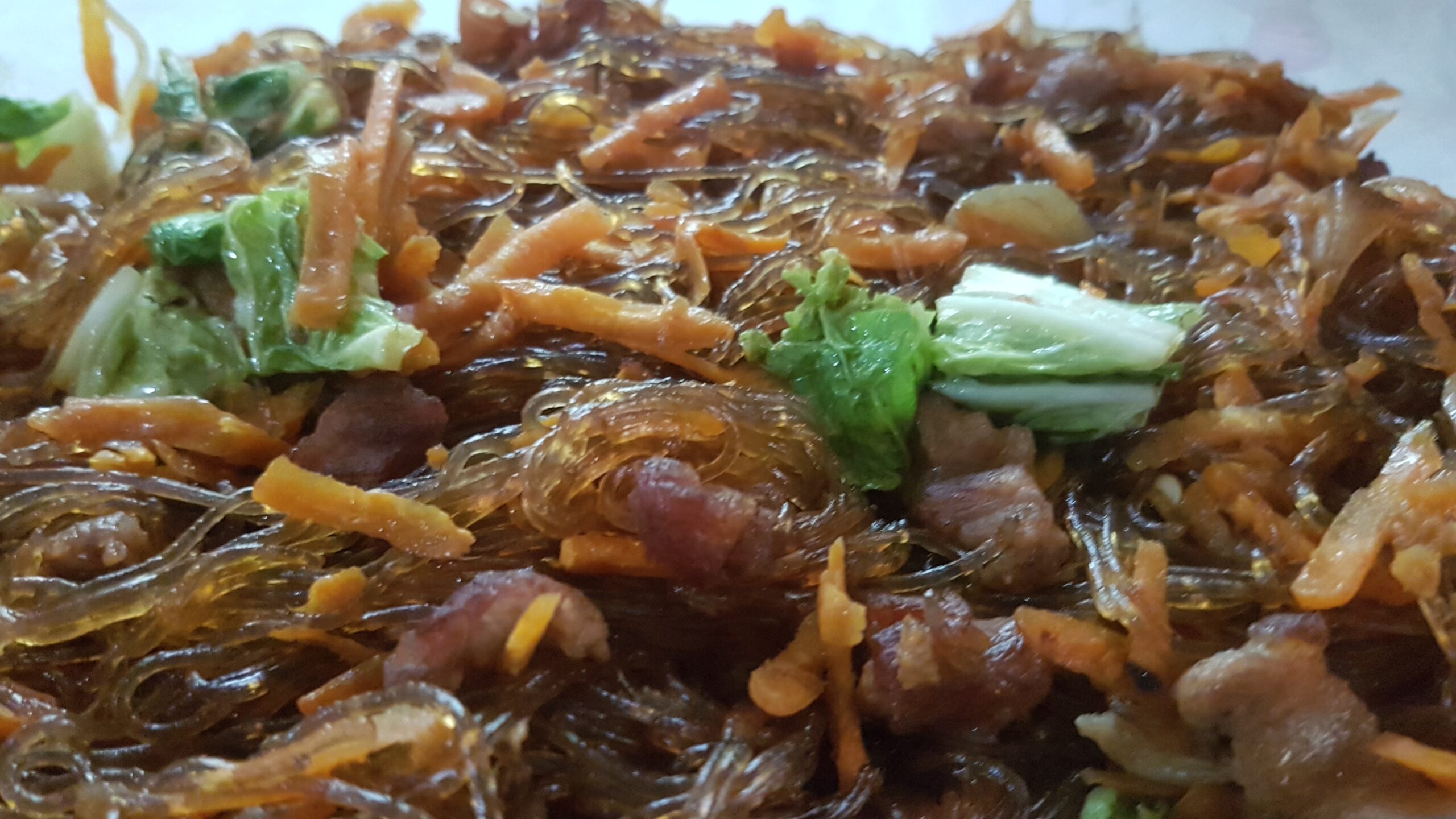
Pancit, a stir-fried noodle dish built on rice noodles or bihon, vegetables, and usually chicken or shrimp, shows up on Filipino-American Thanksgiving tables often enough that it has become close to expected in many households rather than a special addition. Its presence tracks a broader pattern in Filipino celebration cooking generally: noodles are considered a dish for long life and are served at nearly every major family gathering, birthday, and holiday, Thanksgiving included.
What makes pancit durable on this particular table, compared to dishes that fade after a generation, is that it needs no explanation to a guest encountering it for the first time. It looks and tastes like a noodle dish, a category every American guest already understands, which makes it an easy plate to try even for someone who has never sat at a Filipino table before.
The version made for Thanksgiving specifically tends to be more heavily loaded with vegetables and protein than an everyday pancit, closer to a main dish in its own right, and it is frequently the first side dish to run out on the buffet table, ahead of the stuffing.
Tahdig, and the crust that has to come out in one piece
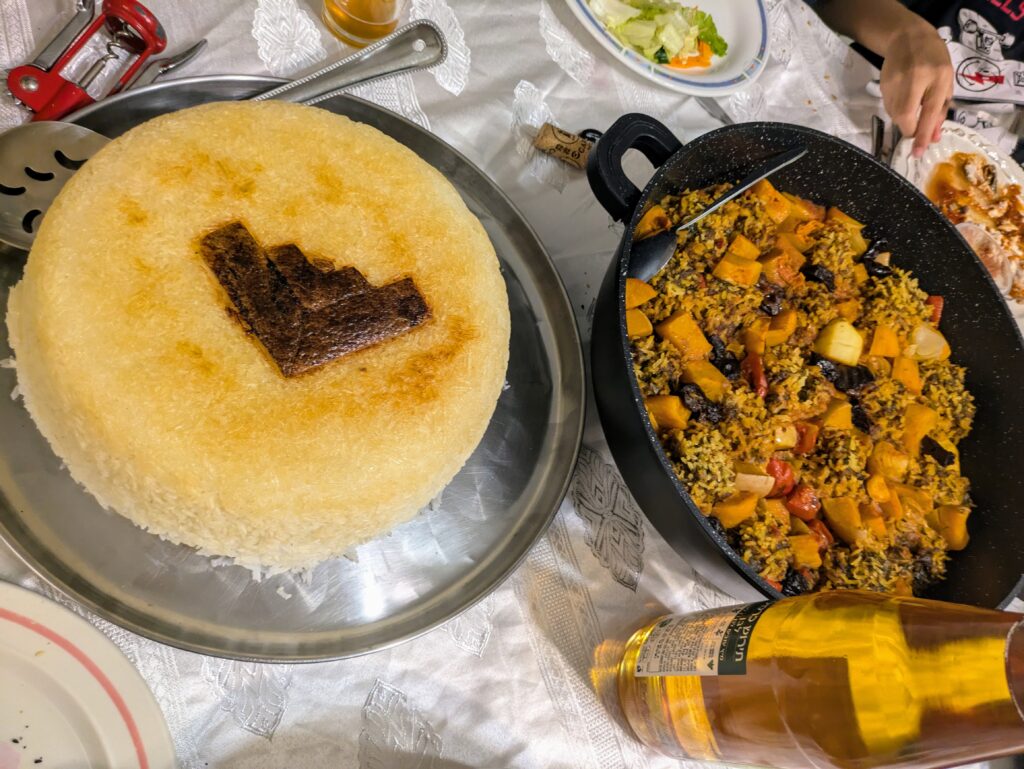
Tahdig, the golden, crackling crust that forms on the bottom of a pot of Persian rice, is a higher-stakes addition to a Thanksgiving table than pancit, because it depends on a single, unforgiving moment: flipping the pot to release the crust intact rather than in broken pieces. Many households consider a Thanksgiving without tahdig on the table incomplete once the dish has been introduced, even though making it well takes real practice.
Rice for tahdig is parboiled, layered back into an oiled pot with saffron and sometimes a base of sliced potato or flatbread beneath it, then cooked low and slow until the bottom layer turns crisp and deeply golden. The rest of the rice steams fluffy above that crust, and the two textures on one plate, soft grain and crackling crust, are usually what a first-time guest remembers most about the dish.
Iranian-American households that keep tahdig on the Thanksgiving table are often making a deliberate choice rather than a default one, since the dish takes real oven or stovetop time on a day when both are already claimed by the turkey. Some solve it by making tahdig the day before and reheating gently, though the crust never quite regains the same crackle a fresh flip gives it.
Farofa, and the crunch a Brazilian table expects
Farofa, toasted cassava flour cooked with butter or oil and often bits of bacon, onion, or egg, is less a side dish in Brazilian cooking than a texture that belongs on nearly every savory plate, sprinkled over rice, beans, and meat alike. On a Brazilian-American Thanksgiving table, it plays that same role: a spoonful over the turkey and stuffing rather than a separate mound on the plate.
Its persistence has a practical explanation beyond taste. Farofa takes under fifteen minutes to make, needs no oven space, and keeps well at room temperature for the length of a long holiday meal, none of which is true of the turkey or most of the classic sides competing for the same stovetop and counter space.
Where tahdig demands a household commit real attention to one dish, farofa asks almost nothing of the day’s schedule, which is likely part of why it is one of the easiest additions for a mixed household, where only one parent grew up with the tradition, to keep making year after year without it becoming a point of friction on an already busy day.
What gets dropped, and the pattern behind it
Across households built around all three dishes, the things that fall away first tend to be side dishes requiring an ingredient that is hard to find locally, a full extra burner on a stove already crowded with gravy and vegetables, or more than about half an hour of hands-on attention beyond what pancit, tahdig, or farofa themselves require.
A second main dish, beyond the turkey, is the most common casualty. Many households that once served a whole separate roasted or braised dish from their country of origin alongside the turkey eventually narrow down to a single starch or side that stands in for the whole tradition, rather than trying to run two full menus in one kitchen on one day.
What stays, and why it becomes as expected as cranberry sauce
The dish that survives past the first generation tends to be the one that guests outside the family actually ask for by name at the next gathering, turning what started as a personal addition into a fixture that would be missed if it disappeared. Pancit and farofa both cross that line easily, since neither one is difficult to eat or explain to someone trying it cold.
Tahdig survives for a different reason: it becomes a point of pride specifically because it is hard to make well, and a household that has mastered the flip treats it the way another family might treat a particularly good pie crust, as proof of skill passed down rather than simply a dish repeated out of habit.
Cooking two traditions in one kitchen, on one clock
The practical constraint underneath all three stories is the same: one oven, one stovetop, and a turkey that dictates most of the day’s schedule regardless of what else is on the table. Pancit and farofa both solve this by needing almost no oven time at all, which is a real advantage on a day when oven space is the single scarcest resource in the house.
Tahdig is the outlier, needing a dedicated pot and close attention during the exact window when a cook’s focus is usually split three ways already. Households that keep it tend to assign it to whichever family member has the least responsibility for the turkey itself, freeing them to watch the rice without also watching a bird.
A menu built from all three, for a household combining traditions
| Dish | Oven or stovetop | Active time needed | Make-ahead friendliness |
|---|---|---|---|
| Turkey | Oven | Low, mostly waiting | Brine a day ahead |
| Pancit | Stovetop | 20 to 25 minutes | Reheats well |
| Tahdig | Stovetop | 45 minutes, focused | Best fresh, reheats acceptably |
| Farofa | Stovetop | 10 to 15 minutes | Holds at room temperature for hours |
A household combining more than one of these on the same table is combining more than a recipe list. It is putting a second, unrelated culinary logic directly on the same plate as the turkey, and the fact that it works at all says something about how absorbent the holiday’s format actually is, closer in spirit to the regional stubbornness covered in our piece on why the South bakes its dressing in its own pan.
Hosting a table that mixes traditions for the first time
A household making one of these three dishes for a mixed table of guests for the first time runs into the same short list of questions every time: how much of the dish to make relative to the rest of the spread, whether it needs its own serving utensil separate from everything else, and how to describe it briefly to a guest who has never seen it without turning dinner into a lecture.
The households that handle this most smoothly tend to treat the dish exactly like any other side on the table rather than setting it apart with a special introduction. Pancit sitting next to the stuffing, described the same way a host would describe the stuffing itself, gets tried by more first-time guests than the same dish presented with a formal explanation of where it comes from and why it matters.
Portioning matters more than it seems. Because these dishes compete directly with stuffing and mashed potatoes for the same spot on a full plate, making enough for every guest to try a reasonable portion, rather than a token amount meant mostly for family, is usually the difference between a dish that becomes a permanent fixture and one that quietly disappears after a year or two.
Frequently Asked Questions
Is it common to serve more than one of these dishes on the same table?
It happens, most often in households where members of the family come from more than one of these backgrounds, though it is more common for a household to center around one tradition alongside the standard American dishes rather than combining several international sides at once.
Do these dishes replace anything from the traditional Thanksgiving menu?
Rarely entirely. Pancit and farofa are usually added alongside stuffing and mashed potatoes rather than replacing them, though the amount of each classic side made sometimes shrinks to make room on the table and on appetites.
Why does tahdig take so much more effort than the other two dishes?
The crust depends on a specific ratio of oil, low heat, and timing that is unforgiving of shortcuts, and the flip itself, turning the pot upside down onto a serving plate, either works cleanly or does not, with no way to correct it once it is underway.
Can farofa be made ahead of the meal?
Yes, and it is one of the more forgiving dishes on this list for that. Made a few hours ahead and left at room temperature, it holds its crunch better than most side dishes reheated after refrigeration.
What is the most common reason a second tradition drops off a family’s Thanksgiving table over time?
Time and kitchen space, more often than a lack of interest. A dish that needs a dedicated burner or oven slot on a day when both are scarce is the first thing to go when the household’s schedule gets tighter across generations.
None of these three dishes needed an invitation to earn a permanent spot on the table. They earned it the way any dish does at a holiday meal, by being good enough that someone asked for it again the following year.