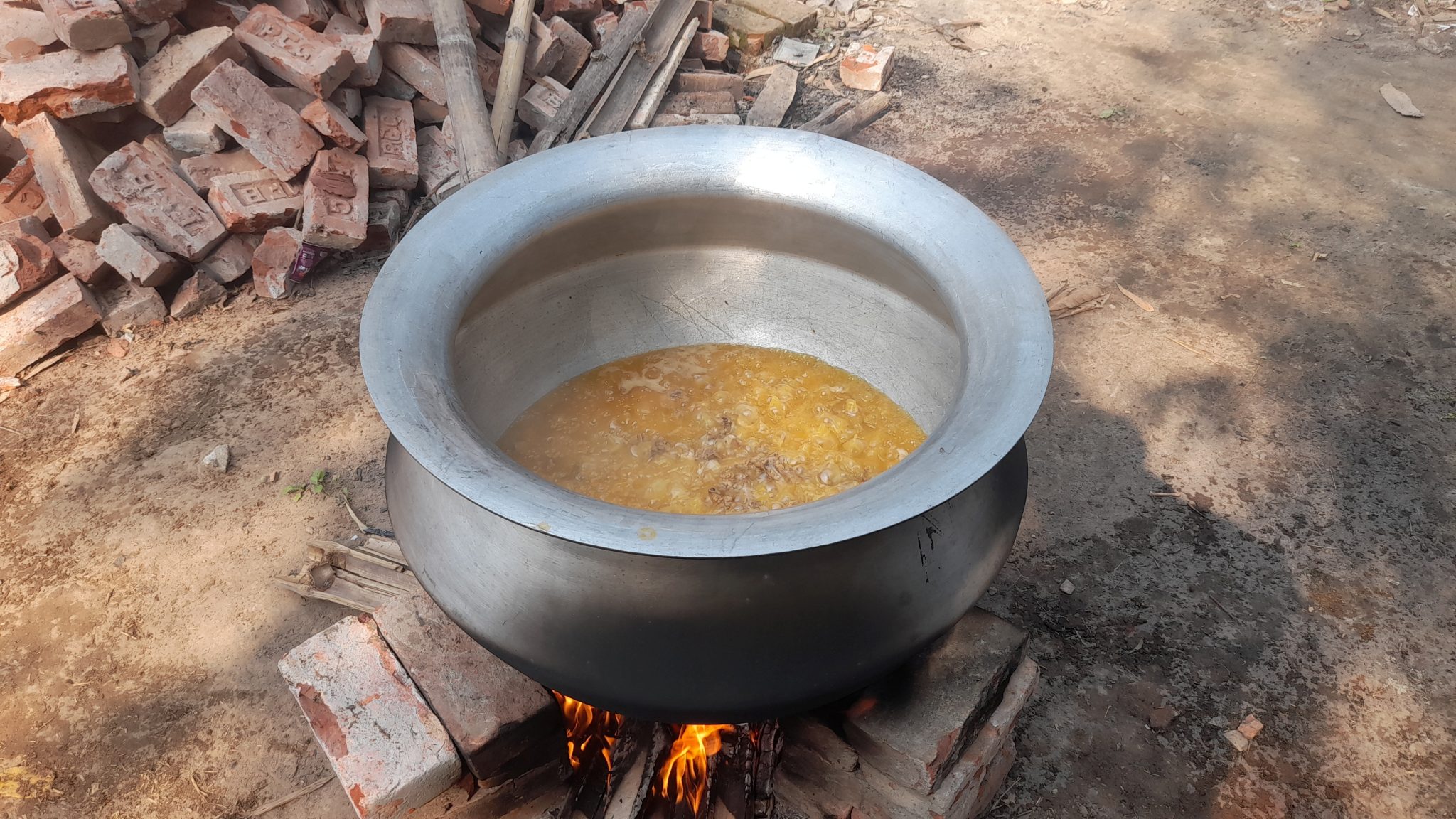
The pot is the size of a bathtub, it sits on a block frame over a wood fire in a field, and two men take turns moving a wooden paddle through it because a spoon is not a serious tool at that volume. It has been going since before dawn. It will be ready sometime in the middle of the afternoon and it will feed everybody who shows up.
That is burgoo in its original form, and it is less a recipe than an occasion with a stew attached. Political rallies ran on it. So did church picnics, fire department fundraisers, county fairs and, in the first week of May, a great many parties in Louisville.
It scales down. A Dutch oven on a Saturday produces the same thing for eight people, and the reasons behind each decision in the big pot survive the reduction intact.
- Meats: three, traditionally including mutton, cooked until they shred on their own
- Vegetables: whatever is around, with four that are effectively required
- Time: six to eight hours at a bare simmer, mostly unattended
- Thickener: the corn, the potato and the collapsed meat. No flour
- Seasoning: Worcestershire, vinegar and cayenne, all added in the last hour
- Yield here: about four quarts, which is eight generous bowls
A pot that is an event, not a recipe
Burgoo belongs to a small category of American dishes that exist mainly to be cooked in quantity for other people. The recipe is secondary to the setting, which is why no two accounts agree on the contents and why almost every account agrees on the scale.
The pattern is consistent across central Kentucky. A community organisation needs to feed several hundred people cheaply. Somebody with a large kettle and a reputation for knowing what he is doing is asked to make burgoo. Meat comes from whoever has it, vegetables come from gardens and from cans, and the whole thing cooks overnight and into the next day.
The association with the first Saturday in May is genuine and long-standing. Burgoo turns up at Derby parties, at the track, and on restaurant menus across Louisville that week, alongside country ham and beaten biscuits. It is not exclusive to the occasion, and in the rest of the state it is more likely to be tied to a church supper than to a horse race.
Where the word comes from, and why it is not settled
Several explanations circulate. One traces it to burgout, a thick oatmeal porridge eaten by sailors and soldiers. One suggests a corruption of barbecue. One proposes a mangled French ragout, and one attributes it to a cook with a speech impediment attempting to say bird stew. Each of these is repeated confidently in print.
None of them is documented in a way that would satisfy anyone looking for evidence. The word appears in American use in the nineteenth century without an explanation attached, and the stories arrived afterward to fill the gap. The honest position is that the etymology is unknown and that the competing accounts are folklore about a word rather than the history of one.
Its Kentucky identity, by contrast, is not in doubt. The stew is made elsewhere in the Ohio Valley and southern Illinois, and it is claimed hardest and cooked most often in Kentucky, where several towns hold annual festivals built around it.
Three meats, and what the mixture is for
The rule everyone agrees on is more than one meat, and the usual count is three. In the old pots this was practical: whoever was cooking used what had been donated, which might be beef, mutton, pork, chicken, or game brought in by somebody who hunted.
It is not only frugality. Each meat contributes something different to a pot that cooks for eight hours. Beef shank and chuck give gelatin and a deep savoury base. Chicken, cooked on the bone, gives a lighter stock and shreds into fine threads that thicken the liquid. Mutton or lamb gives the fat and the distinctive flavour that makes burgoo taste like burgoo and not like a general stew.
Cook them on the bone and cook them separately if there is room. Simmering a whole chicken and a beef shank in the same pot for two hours, then pulling the meat and returning the strained stock, gives a cleaner result than dumping everything in at once. In a big pot nobody bothers. In a Dutch oven it takes twenty extra minutes and is worth it.
Mutton is traditional, and lamb is the substitute
Western Kentucky has a mutton tradition that is unusual in the United States, and it shows up in barbecue as well as in burgoo. Mutton is sheep older than about two years, and it is strongly flavoured, fatty and inexpensive where it is available. It stands up to eight hours of simmering better than almost any other meat.
It is genuinely hard to buy in most of the country. Halal butchers are the most reliable source, and some farm suppliers sell it in autumn. Lamb shoulder is the standard substitute and it is milder, leaner and considerably more expensive, so a pot made with lamb tastes less like the original and costs more.
Leaving it out entirely is a legitimate choice and produces a good stew that is closer to a beef and chicken pot. If that is the route, add a little more beef fat and a heavier hand with the Worcestershire, both of which recover some of the depth the mutton was providing.
The vegetables are whatever is around, except four
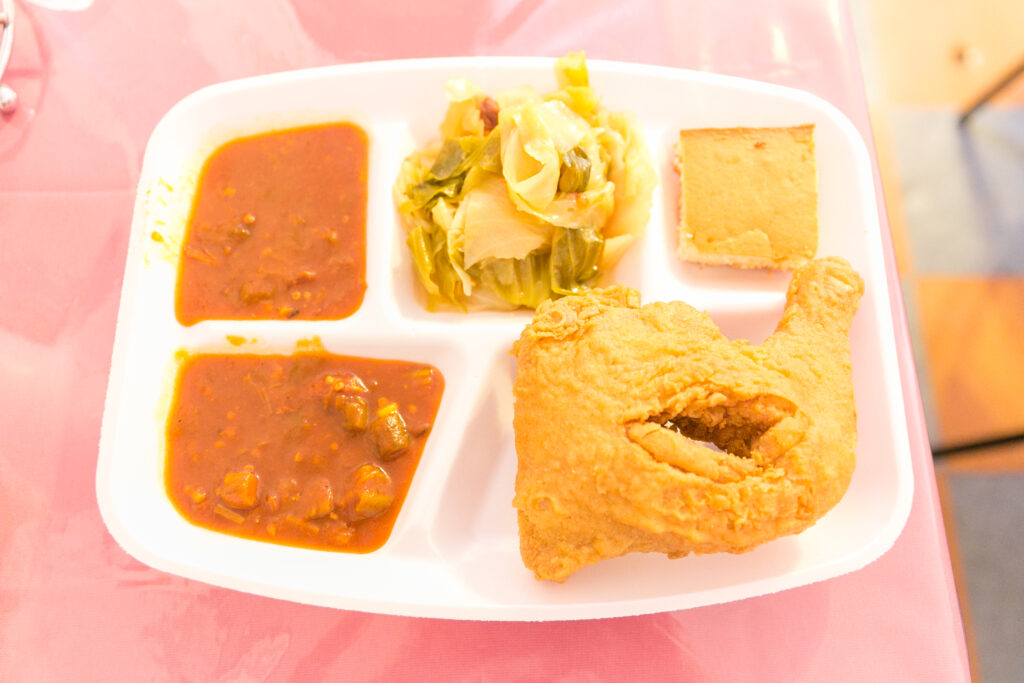
The improvisational reputation is accurate: cabbage, okra, green beans, turnip, celery and carrot all turn up depending on the cook and the month. What is not optional is a group of four, and a pot missing any of them stops being recognisable.
Corn thickens as its starch releases and supplies most of the sweetness. Lima beans break down at the edges and do the same job with a different texture. Potato disintegrates almost completely over eight hours and is the main body of the finished stew. Tomato supplies the acid that keeps the whole thing from tasting flat and heavy.
Frozen and canned are correct here, not a compromise. This is a winter and early spring dish in a region where none of these were available fresh in those months, and the long cooking time destroys any advantage fresh vegetables would have had. Frozen corn and lima beans go in whole; canned tomatoes go in with their liquid.
Eight hours, and what happens in them
The first two hours are meat cookery: connective tissue converting to gelatin, the stock building, the meat becoming shreddable. Nothing about the finished texture is visible yet and the pot looks like watery soup with vegetables in it.
Hours three to five are where it becomes burgoo. The potato starts to break, the corn releases starch, the lima beans soften and split, and the liquid thickens noticeably. The individual vegetables stop being identifiable one at a time. This is also when the pot needs stirring often enough that nothing settles and scorches on the bottom.
The last two or three hours are reduction and integration. Volume drops, the colour goes from red-orange to a deeper brown-orange, and the texture arrives at the traditional test: thick enough that a spoon stood upright in it will lean slowly rather than fall. That is the target and it is reached by patience rather than by any added thickener.
A kentucky burgoo recipe for a Dutch oven
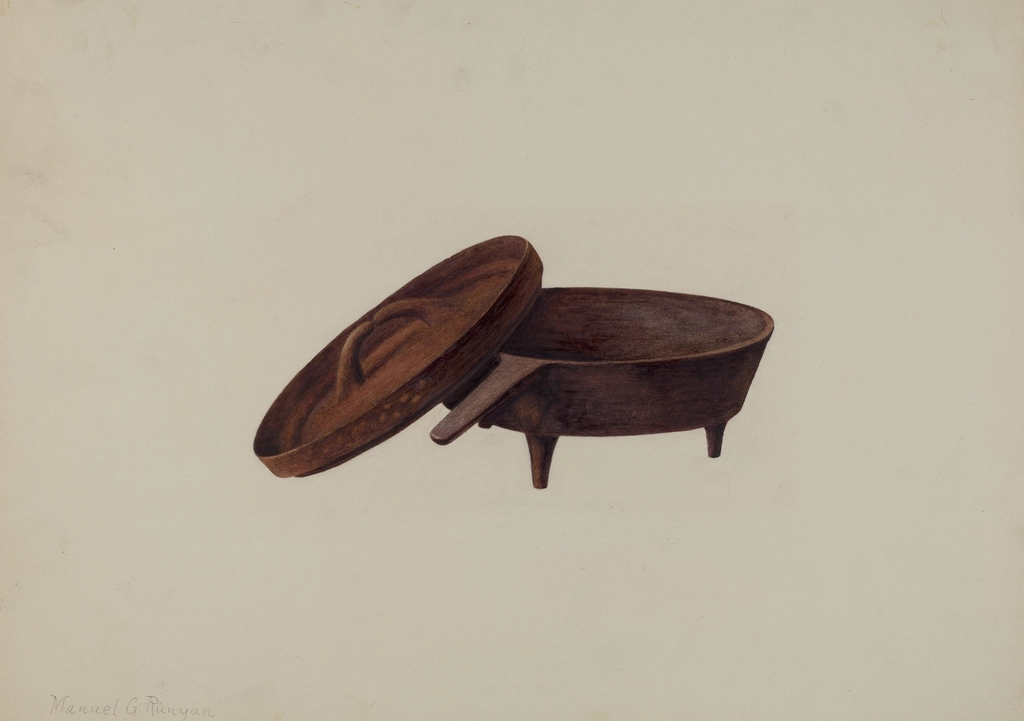
- Simmer a pound of beef shank, a pound of lamb or mutton shoulder and a three-pound chicken in four quarts of water with a bay leaf and a halved onion, two hours, skimming the foam in the first fifteen minutes.
- Lift out the meat and let it cool. Strain the broth and return it to the pot.
- Pull the meat off the bones in shreds, discarding skin, fat and gristle. Return it to the broth.
- Add two large potatoes in half-inch dice, two diced onions, two carrots, a 28-ounce can of tomatoes with the liquid, and two cups of frozen lima beans.
- Simmer uncovered three hours. Stir every twenty minutes and scrape the bottom each time.
- Add two cups of frozen corn and, if using, a cup of sliced okra or shredded cabbage. Simmer two hours more.
- When the potato has broken down and the stew coats a spoon heavily, start the seasoning.
- Add a quarter cup of Worcestershire sauce, two tablespoons of cider vinegar, a teaspoon of cayenne and a tablespoon of black pepper. Simmer thirty minutes.
- Taste and adjust salt, vinegar and cayenne in that order. It should be assertive rather than gentle.
- Rest it off the heat twenty minutes before serving with cornbread.
From a hundred servings down to eight
| Component | Community pot, about 100 servings | Dutch oven, 8 servings |
|---|---|---|
| Total meat, bone in | About 40 pounds | 5 pounds |
| Liquid at the start | 25 to 30 gallons | 4 quarts |
| Potato | 25 pounds | 2 pounds |
| Corn and lima beans | 15 pounds combined | 4 cups combined |
| Cooking time | 12 to 24 hours | 7 to 8 hours |
| Stirring | A wooden paddle, near constantly | A long spoon, every 20 minutes |
The proportions hold better than the times do. A very large pot loses heat slowly and cooks far longer at the edges than a small one, which is why the big-kettle version runs overnight and the home version does not need to. Anyone who has worked through the arithmetic of cooking for a crowd will recognise that cooking time does not scale linearly with volume.
The seasoning goes in late
Worcestershire, vinegar and cayenne all go in during the last hour and there is a reason for each. Worcestershire carries a fermented anchovy note that gives the pot depth, and it fades badly over a long simmer, so adding it at hour one wastes most of it.
Vinegar sharpens a stew that has spent eight hours turning sweet and soft, and its aroma is volatile, so early addition leaves only sourness behind. Cayenne bloom builds over time in a pot and a quantity that tastes correct at hour two will be uncomfortable at hour eight.
Salt is the exception and needs adding in stages, since the pot reduces so much. Salt at the beginning for the meat, again when the vegetables go in, and a final adjustment at the end. A pot salted only at the start will taste flat, and one salted only at the end will taste like salted stew rather than seasoned stew.
Burgoo, brunswick stew, and a plain beef stew
Burgoo and brunswick stew are cousins and the confusion between them is reasonable. Both are long-cooked multi-meat community stews built on corn, beans and tomato, both were historically cooked outdoors in quantity, and both are claimed regionally with some heat. The differences are real but narrow.
Burgoo generally includes mutton or lamb, runs to more vegetables, and carries more black pepper and cayenne. Brunswick stew is usually built on pork and chicken, leans sweeter and tangier depending on which state is making it, and often has a barbecue-sauce character that burgoo does not. Burgoo is thicker and more uniform; brunswick stew tends to keep more identifiable pieces.
Neither has much in common with an ordinary beef stew, which is built on browned meat, a smaller vegetable list and a shorter cook, and which aims for distinct components in a sauce. Burgoo aims for the opposite: everything collapsed into one thing. That is also what makes it the sort of pot people cook in cold weather and eat for three days.
Holding it hot on a long afternoon
The community version raises a food safety question the home version does not, and it is worth being direct about it. A stew served out of a kettle over several hours at a picnic has to stay above 140 degrees the whole time, which means the fire stays lit and somebody checks with a thermometer rather than by eye. A pot allowed to drift down to lukewarm while people come and go is the classic setup for trouble.
The same applies to transport, which is how most burgoo actually reaches a gathering. Move it hot in a covered pot and get it back onto heat at the other end, or move it cold and reheat it to a full boil on arrival. The one thing not to do is carry a warm pot for two hours and then hold it warm for three more.
At home, portion what is left into shallow containers rather than refrigerating the whole Dutch oven, because a deep pot of thick stew takes many hours to cool through. It keeps five days and freezes for three months, and like most things in this category it is better on the second day than the first.
Frequently Asked Questions
Can I make it with two meats instead of three?
Yes, and beef with chicken is the most common reduction. What is lost is the fat and the particular flavour that mutton contributes, so compensate with a little more beef and a heavier hand on the Worcestershire and pepper. One meat alone makes a decent stew that is no longer burgoo.
Is squirrel or rabbit still used?
Old recipes across the region call for game and some cooks still include it where it is available. In practice almost every pot made today uses farmed meat, and the game reference in printed recipes is largely historical. The dish does not suffer for its absence.
Can it be made in a slow cooker?
Partly. Cook the meats and build the stock on the stove, then transfer everything to a slow cooker on low for eight hours. What will not happen is the reduction, since a slow cooker traps its moisture, so plan on an hour uncovered on the stove at the end to get the thickness.
How thick should it actually be?
Thick enough that a spoon left standing in the middle leans over slowly rather than falling at once. If it pours like soup it needs another hour uncovered. If a spoon stands rigid it has gone too far and wants a cup of stock stirred back in.
What is served with it?
Cornbread, almost always, and often a slaw with vinegar in it to cut the richness. Beyond that nothing is needed, since the stew contains the meat, the vegetables and the starch. It is a one-bowl meal and treating it as a side dish sells it short, the way a lot of regional food gets miscast when it travels.
Start it on a Saturday morning with the radio on and check it every twenty minutes until mid-afternoon. It asks for very little attention and a great deal of patience, which is the trade every dish in this category makes, and it is why the pot got so large in the first place.